

What are the different views on the Origin of the Universe — Creation and Evolution?

Young Earth Creation, Day-Age Creation, Progressive Creation, Gap Theory, Theistic Evolution, Intelligent Design, Naturalistic Evolution
Did God create everything? Does evolution explain the origin of the universe? Is the earth young or old? Learn more about the seven most prevalent views and the pros and cons of each.

Image credit: BibleSurf.com, Answers In Genesis
Here's a short summary of each view — more details are lower on this page
1. Young Earth Creation (six days)
God created the world in six 24-hour days, approximately 6,000-10,000 years ago. This view is the most literal interpretation of the book of Genesis in the Bible.
2. Day-Age Creation
The six days of God’s creation in Genesis chapter 1 are long geologic ages rather than 24-hour days.
3. Progressive Creation
The universe starts with the Big Bang, and the six days of God's creation are long ages, resulting in an old earth. God creates all life forms, but not through Darwinian evolution.
4. Gap Theory Creation
There is a long gap of time (millions of years) between the first two verses in Genesis. God created the world in verse 1, then destroyed it during the gap. Then, God began a literal, six 24-hour day creation.
5. Theistic Evolution
God initially created the universe, and then evolution took over. A secondary view is that God also created some of the first life forms on earth, and then He let evolution run its course.
6. Intelligent Design
The complexity of life requires an intelligent designer. This view is opposed to random chance evolution. It stops short of identifying who is the designer or addressing the age of the earth.
7. Evolution (Naturalistic or Atheistic)
The universe began with a Big Bang, and life gradually evolved from stardust to simple cells to complex creatures via random, chance mutations and natural selection without any divine intervention or purpose.
1. What is Young Earth Creation?
God created the world 6,000-10,000 years ago in six days

Image credit: Answers in Genesis
This is a popular view among Christians where God created the world in six 24-hour days approximately 6,000-10,000 years ago.
Genesis 1 describes what God created on each of the six days:
Day 1: Light and dark
Day 2: Sky (atmosphere) and water
Day 3: Dry land with vegetation
Day 4: Sun, moon and stars
Day 5: Birds and sea life
Day 6: Land animals and humans
Day 7: God rested on the Sabbath day
Here are a few arguments to support 24-hour creation days.
Literal days defined
The Hebrew word for day (“yom”) appears in the Old Testament over 2,000 times and it may be interpreted either as a 24-hour day or a long period. But when day appears with “evening” and “morning” or a “number,” it always means a 24-hour day.
Old Testament — Fourth Commandment confirms creation in six days
Exodus 20:8-11 says, “Remember the Sabbath day, to keep it holy. Six days you shall labor and do all your work, but the seventh day…you shall not do any work…For in six days the Lord made the heavens and the earth, the sea and all that is in them, and rested on the seventh day.”
This is the basis of our seven-day week with one literal day of rest. If one argues that a day is symbolic, then do we work for six million years and then rest for one million years?
Jesus confirms God created Adam and Eve in the beginning
Even Jesus confirmed creation in Mark 10:6 when He said, “But from the beginning of creation, God made them male and female.” He said he created Adam and Eve in the beginning of creation, not billions of years after creating the universe.
The Apostle Paul confirms God as the creator of everything
The New Testament confirms God created all things when it says, “For by Him all things were created, both in the heavens and on earth, visible and invisible…all things have been created through Him and for Him.” (Colossians 1:16).
Read more:
What is Young Earth Creationism? on GotQuestions.org.
Age of the Earth: 6,000 Years Ago? on GenesisApologetics.com.
Could God Really Have Created Everything in Six Days? on AnswersInGenesis.org.
Young-Earth Creationist View Summarized And Defended on AnswersInGenesis.org.
Watch videos:
Popular videos on Creation vs Evolution on BibleSurf.com (this site).
2. What is Day-Age Creation?
Each day of creation is a long age and harmonizes with an old earth

Day-Age Creation says the six days of God's creation in Genesis chapter 1 were sequential, long periods of time (maybe millions or billions of years) that correspond roughly to the geologic ages.
This view tries to harmonize the six days of Biblical creation with a supposed old earth (4.6 billion years) and old universe (13.8 billion years).
Support for Day-Age Creation
One key verse that is relied upon is 2 Peter 3:8-9, which says “…with the Lord one day is like a thousand years, and a thousand years like one day...The Lord is not slow about His promise...but is patient toward you, not wishing for any to perish but for all to come to repentance.”
This verse is not talking about creation days but God being patient with man’s rebellion, giving them time to repent. It is a simile, and it says one day is “like” a thousand years. It does not say a day “is” a thousand years. The verse says God is outside of time, or His timing for judgment is not the same as our timing.
Arguments against Day-Age Creation
1. Plants would die without the sun, which was created later
God made plants on day three and the sun on day four. If day three was a thousand years, how would the plants survive without the sun for a thousand years?
2. Plants would die without pollinators, which were created later
Most plants created on day three need pollinators to survive. But pollinators like bees, butterflies, flies, and birds were created on day five or six. Without pollinators for thousands of years, about 75-95% of all flowering plants would have died off along with about three-quarters of our food crops.
3. A day in Genesis 1 is a literal, 24-hour day, not a long period
When Genesis 1 describes a day with a number, morning, and evening, it always means a literal day elsewhere in the Old Testament.
Progressive Creationists and Theistic Evolutionists have adopted this Day-Age view but added other details.
3. What is Progressive Creationism?
Big bang and old earth are combined with God's creation over billions of years

Image credit: Bible Surf
This view incorporates the ideas of Day-Age Creation but with more details.
-
The Big Bang occurred about 13-15 billion years ago
-
The Earth formed about 4.6 billion years ago
-
Creation days were long, varying periods
-
Noah's Flood was regional and did not create the fossil record
-
God created new species over millions of years
-
Death and disease existed before Adam's sin
-
Nature is like the 67th book of the Bible that deals with science
-
God created soulless, man-like creatures 2-4 billion years ago — They painted on cave walls and used tools but went extinct before God created Adam and Eve about 55,000-120,000 years ago.
Like other old earth theories, this view helps Christians harmonize the apparent old age of the earth with the Genesis story of creation. Dr. Hugh Ross has written several books that have popularized this view.
Arguments against Progressive Creationism
1. Contradicts the literal 24-hour creation days in Genesis 1.
2. Contradicts multiple verses that state Noah's Flood covered the whole earth.
3. Rejects the idea that the Garden of Eden was free from death and disease before Adam's fall.
4. Elevates the “record of nature” to be equal with the revelation of God in the Bible.
5. Contradicts the order of days of creation in Genesis 1 by adopting the secular evolutionary sequence of creation (stars before day 4).
6. Accepts God as the creator of mature humans without evolution but does not accept God creating other components of the universe as mature.
This is just a high level summary of a few of the pros and cons of Progressive Creationism.
4. What is Gap Theory Creation?
Creation, then Gap (destruction), then second Creation
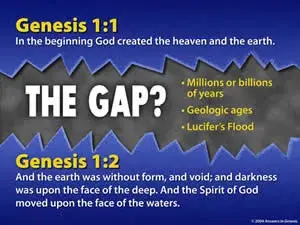
Image credit: Answers in Genesis
This view puts a large gap of time between the first two verses in Genesis. In the first verse, God created the world. Then God destroyed the earth. The second verse describes the destroyed earth. In the third verse, God began a literal, six-day creation.
First Creation in verse 1
Genesis 1:1 says, “In the beginning God created the heavens and the earth.” The earth is created. It is assumed God created plants and animals in verse 1 as well, which became the source of the fossil record found today.
The Gap in verse 2 (earth is destroyed)
It’s presumed God judged the devil for rebelling against Him and cast the devil down to earth. Then God destroyed the earth with a flood, sometimes called Lucifer’s Flood, which shaped the earth into the various geologic columns where fossils are buried today. The flood reduced the earth to a “formless and void” state described in Genesis 1:2, “The earth was formless and void, and darkness was over the surface of the deep, and the Spirit of God was moving over the surface of the waters.” This gap lasted for millions or billions of years.
Second Creation in verse 3 (six 24-hour days)
God starts over in verse 3 and recreates the earth in six 24-hour days of creation.
This theory helps Christians harmonize the apparent old age of the earth with the literal Genesis story of creation. It was popularized by the Scofield Reference Bible, but it has since lost favor to other views.
Argument against it — death contradicts creation being very good
One of the problems with the Gap Theory is that death must have entered the world before the fall of Adam based on the fossil record. However, this contradicts what God said after six days of creation when He said, “it was very good” (Genesis 1:31). Instead, Young Earth Creationists believe Noah's Flood is the reason for the death and destruction in the fossil record.
5. What is Theistic Evolution?
God had a role in creation, then evolution ran its course

Image credit: Answers in Genesis
Minor role: God creates the initial universe only
One position of this view says God created the initial building blocks of the universe, then stepped back and let life evolve from non-living material. This view helps explain the initial origin of the universe, but not how life began.
Larger role: God performs constant miracles when evolution fails
Another position is that God also created the first life form. Evolution then took over, and life progressed from simple cells to complex cells, similar to Darwin’s evolutionary tree. But when evolution failed, God stepped in with mutations to continue the advancement of life.
Both postions acknowledge God was needed to overcome the impossibility of life happening by random chance over billions of years.
Adam and Eve were myths, or they evolved
Most followers say Adam and Eve were myths or that they evolved from an apelike creature. If true, then God must have inserted a soul into them when they eventually evolved to being fully human.
This view is a compromise between what the Bible says and what the world says, and is in direct conflict with what the Bible says.
6. What is Intelligent Design?
A complex world points to a designer, not random evolution

Image credit: BibleSurf.com
This scientific theory asserts that certain features of the universe and living things are best explained by an intelligent cause, not via some purposeless, blind, unguided process.
A watch points to a watchmaker
Intelligent Design looks at the complexity of life and concludes there must be an intelligent designer. It’s analogous to seeing a watch and knowing there was a watchmaker.
The designer of the world is unspecified
Intelligent Design stops short of saying who the designer is. It could be God, or aliens, or something else. Since biblical creation was taken out of school textbooks, Intelligent Design offers a counterargument to evolution in public schools without being religious.
The age of the earth is unspecified
Intelligent Design avoids specifying the age of the earth, whether young or old.
Explains the Origin of Life which Darwin avoided
Intelligent Design deals with three areas of origins that Darwinian evolution is virtually silent on. It deals with the origin of life, physics and cosmology, and biological complexity.
Irreducible Complexity and the Flagellar Motor
One biological argument for Intelligent Design is a term called “Irreducible Complexity,” popularized by biochemist Michael Behe. It states that certain biological systems have several well-matched parts that are too complex to have evolved through small, gradual, step-by-step modifications. If you remove (or reduce) one part, the entire system ceases to function. For example, if you remove the spring in a mousetrap, you break the mousetrap.

The prime example of this argument is the flagellar motor found in human sperm cells, some plants, and bacteria. The motor is so intricately complex that it would be impossible for all of its parts to evolve simultaneously. Therefore, its irreducible complexity points to an intelligent designer.
The odds of a life-friendly universe via evolution are virtually zero
In the area of cosmology (physics and astronomy), the odds of a life-friendly universe appearing by chance are less than one part in 10 raised to a power of 10 with 123 zeros after it (Discovery Institute). Essentially, the odds are zero.
Both religious and secular people believe in Intelligent Design
Some Christians view Intelligent Design as only a partial argument against evolution since it doesn’t point people to God the creator. After all, some Jews, Muslims, and non-religious people also believe in Intelligent Design. Intelligent Design is considered by some as a non-confrontational subset of creationism for this reason.
Read more:
What is the Intelligent Design Theory? on GotQuestions.org.
Bacterial Flagella—Icon of Intelligent Design on AnswersInGenesis.org.
Human Hearing System: Amazing Design? on GenesisApologetics.com.
Marine Mammals: Designed for Deep Diving on ICR.org.
Watch videos:
Popular videos on Creation vs Evolution on BibleSurf.com (this site).
7. What is Evolution? (Naturalistic or Atheistic)
The universe evolved through naturalistic processes without God

Image credit: Answers in Genesis
Naturalistic evolution is the most popular view in the non-religious community and is based on the world beginning with a Big Bang, then the stars, sun, and planets forming. Then Darwinian evolution occurred regarding life forms—all without any guiding divine influence or purpose.
-
The Big Bang: The universe came into existence about 13.8 billion years ago with an expansion of space and matter, but no one knows the cause of it or where it came from. As the universe expanded, stars and planets evolved from the matter in space over billions of years.
-
Earth and Planets: About 4.6 billion years ago, the earth and planets were formed after being spun off from the sun.
-
Moon: The moon began forming about 4 billion years ago after a planet struck the earth and sent debris into space that evolved into the moon.
-
Origin of Life: Life began on earth about 4 billion years ago, but evolutionists don't know how non-organic matter like carbon, iron, or sulfur turned into organic living cells like bacteria. One idea is the primordial soup theory, where the early atmosphere created chemical reactions in shallow pools to make the first living cells. There’s also the panspermia theory, where simple microbes were delivered to Earth by meteors or comets, but where these came from is really just a guess.
-
Darwinian Theory: Charles Darwin’s starting point for his evolutionary theory was that life had already begun. He believed that over long ages life evolved from simple-to-complex cells through small, random, chance mutations. He developed a “natural selection” theory of survival of the fittest to arrive at all life forms on Earth today.
Evolutionary progression of life — stardust to humans
In simple terms, human life progressed from stardust to a single cell to complex cells to multicellular organisms, then sponges to fish, then amphibians to reptiles, then mammals to ape-like creatures, and, ultimately, to humans.
Does science contradict Evolution?
The evidence for evolution, or lack of it, raises many questions
1. Age of the Universe is questioned by evolutionists
Due to estimates of an expanding universe, evolutionists say you can go backward in time about 13.8 billion years to a beginning—a single point. This explosion from nothing supposedly created everything, called the “Big Bang.” However, NASA’s James Webb space telescope is now seeing mature galaxies that may be 33 billion years old, which calls into question the original origin of the universe 13.8 billion years ago.

2. Big Bang started out as a derogatory term
The “Big Bang” was actually a sarcastic, derogatory remark coined by the English astronomer Fred Hoyle, who disliked the theory that the universe had a beginning. The theory says space and time began with the Big Bang. The bigger problems are what happened before the Big Bang? What force caused the initial Big Bang? Where did the matter come from in the Big Bang? Some say everything came from nothing. Others say everything came from a dense inflationary vacuum. These guesses violate all natural laws unless you have an intelligent designer.
3. Origin of Life can't be explained by evolutionists
Evolution has not been able to explain how “non-life” (non-organic material) turned into “life” (organic material). It would violate the laws of nature if it happened this way. Stardust-to-people or particles-to-people is impossible.
4. Cambrian Explosion (earliest life) shows fully developed creatures
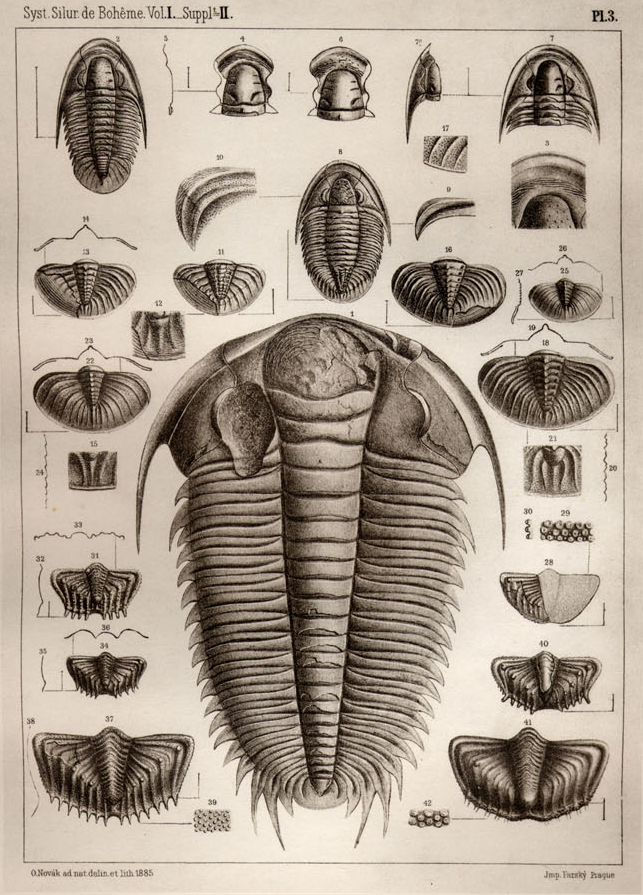
The first life forms appear suddenly in the lowest geologic fossil layer, such as trilobites (over 20,000 species), ranging in size from less than one inch to over two feet. They were fully formed with complex, compound eyes with thousands of lenses in a single eye. This contradicts life evolving over vast ages.
5. Dinosaur bones with blood and collagen can't be that old
Dinosaur fossils have been found with the breakdown components of blood vessels and stretchable collagen that couldn’t have survived millions of years. However, evolutionists claim dinosaurs died off 65 million years ago.
6. Darwin's Evolutionary Tree gets contradicted by DNA
Darwin's Tree of Life says our common ancestors started out as a single cell, then kept mutating upwards to creatures like fish and ultimately to humans that appeared about 300,000 years ago. Yet DNA refutes this progression when they discovered the DNA in a single cell of a lungfish to be 40 times larger than the DNA in a human cell.
7. Darwin and eyeball complexity (defies natural selection)
Darwin had problems with his theory when he saw all the different components of the eye that had to evolve simultaneously for eyesight to work. This violated his natural selection theory.
8. Darwin's theories needed rescuing devices
When Darwin’s theory hit a time-period roadblock, he developed another theory of “macroevolution” (big jumps in evolution) instead of “microevolution” since a slow progression of random mutations took too long to create the complexity of life. He also came up with “sexual selection” as certain creatures like the peacock violated his “natural selection” theory.
9. No “Missing Links” (Lucy was just an ape)
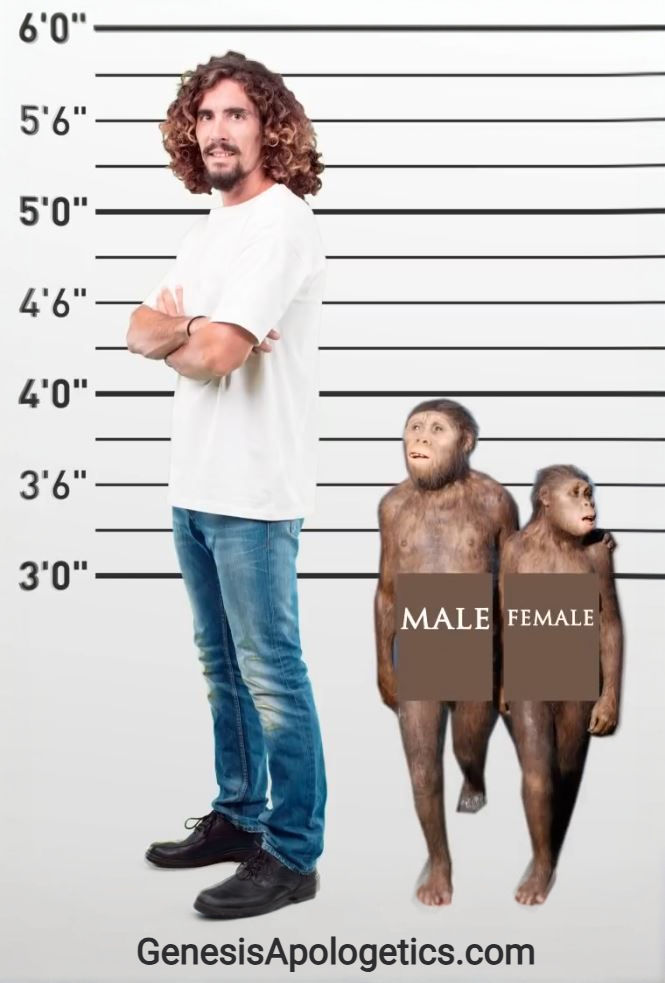
There are no in-between ape-to-human creatures living today, but they should be everywhere if evolution were true. There's no fossil evidence either. Lucy, the prime example of a transitional creature, was determined to be just a 3.5-foot-tall ape. Other missing links like Nebraska Man and Piltdown Man were outright frauds.
10. Noah’s Flood is the primary cause of fossil/rock layers
Creationists point to a worldwide flood that buried plants and animals all over the world in the fossil layers we see today. For example, in the Hell Creek Formation in Montana, dinosaur fossils have been found alongside five shark species and 14 species of fish fossils. Did a tropical storm deposit the sharks and fish? No. A catastrophic, worldwide flood is about the only logical explanation.
11. Bent Rock Layers indicate a young earth, not millions of years
When you look at the Grand Canyon and other canyon walls around the world, you'll see bent and folded rock layers. These wavy layers are from moist, flood sediment laid down over a short period of time. There can't be millions of years between these layers; otherwise, each layer would have hardened first, then cracked when pressured. This evidence points to a global flood and a younger earth, not millions of years between rock layers.

12. Radiometric Dating (10-year-old rocks tested for millions of years)
Ten years after the Mount St. Helens volcano erupted in Washington, rock samples were taken from the lava dome that formed. They tested at ages between 340,000 years and 2.8 million years when they were only ten years old. These data show radiometric dating does not give accurate results, and evolutionists can't reliably date the earth's origin.

These are just a few of the many examples of cosmology, biology, and archeology that question the believability of an old earth or naturalistic evolution.
The Young Earth Creationist takes the Bible literally, where God created man as a mature adult, just like he created everything else mature. That includes the universe, stars, planets, animals, and everything else.
Read more:
10 Best Evidences for a Young Earth and Creation on AnswersInGenesis.org.
Does the Big Bang Fit with the Bible? on AnswersInGenesis.org.
What Explains the Cambrian Explosion? on AnswersInGenesis.org.
Radiometric Dating: Is the Earth is 4.5 Billion Years Old? on GenesisApologetics.com.
Lucy the ape is NOT the “missing link” on BibleSurf.com (this site).
DNA contradicts Darwin's “Tree of Life” on BibleSurf.com (this site).
What does the Bible say about creation vs. evolution? on GotQuestions.org.
Confirmed New Record for Most Distant Galaxy (Big Bang problems?) on ICR.org.
Watch videos:
Popular videos on Creation vs Evolution on BibleSurf.com (this site).
What is the best Biblical view of origins?
Christians generally believe in creationism (not evolution), but vary in their beliefs regarding a young earth or old earth

Image credit: BibleSurf.com
Bible scholars usually apply a literal interpretation to Genesis since it is a historical narrative on creation. However, there are poetic books in the Bible, such as Psalms, that are highly figurative and prioritize the use of metaphors, imagery, and emotional language.
So is Genesis narrative or figurative?
People who believe Genesis is a historical narrative would likely be young-earth creationists. But if Genesis is full of symbolic and figurative language, then they may lean towards an old-earth view. The reality is, most people haven't given it much thought.
However, if one believes in pure evolution, they're throwing out the heart of the Bible.
Most theologians agree that your view of the timing and method of God's creation is not a salvation essential but a secondary issue. Can anyone prove their position? No. None of us were there to witness it.
BibleSurf takes a young earth, literal, and historical interpretation of Genesis and generally posts videos and articles that reflect this view. However, there are a few pastors or speakers who don't take a dogmatic view one way or another, or they take an old-earth view of creation.
One final note — many of the greatest scientists of the past were creationists
One of them even established the “scientific method”

Image credit: Answers In Genesis
These scientists were Bible-believing Christians and believed God had supernaturally created all things, each with a complex structure for its own unique purpose.
-
Isaac Newton — Calculus
-
Louis Pasteur — Bacteriology
-
Carolus Linnaeus — Classification System
-
Michael Faraday — Electromagnetics
-
Blaise Pascal — Hydrostatics
-
Lord Kelvin — Thermodynamics
-
James Maxwell — Statistical Thermodynamics
-
Johann Kepler — Celestial Mechanics
-
Francis Bacon — Scientific Method
You're in good company if you believe in Biblical creation like these top scientists did!
Common questions about origins
Q: What caused the Big Bang?
A: No one has a good explanation. The Big Bang is based on random chance, like flipping a coin. But you need a force to flip the coin. So, what force caused the Big Bang in the first place is a question that evolutionists can't answer.
Q: How did males and females evolve simultaneously?
A: They didn't. Their reproductive organs are too different to have evolved simultaneously. Females are only fertile for maybe 25-40 years. If male organs didn't evolve suddenly for reproduction to take place during a female's fertile 40 years, both males and females would have died off.
Q: Which came first — the chicken or the egg?
A: The chicken. God had to create them mature. An egg needs the warmth of a hen, and once it hatches, it needs a hen to feed it; otherwise, the chick would die. In the same way, logic tells us that God had to create all creatures mature.
Evolutionists say birds evolved from reptiles that eventually laid the egg that hatched as a chicken. Therefore, the egg came first if you are an evolutionist. Your worldview dictates your answer.
Q: Why should I care about how God created the world?
A: Our education system has brainwashed us that evolution is a scientific fact. Yet, the Bible contradicts evolution. Some people struggle to reconcile this gulf between evolution and creation and end up drifting away from their faith. Through creation education, we can close this gulf when people realize evolution is not a proven scientific fact and they discover the many logical and scientific arguments against evolution.
Q: I don't know where I fit with all the origin views. Can I just believe God created everything?
A: Yes. Many people fall into this camp. They believe in God the creator and don't want to get bogged down into the details of how God did it. Almost every church will have believers who are undecided about their views on a young earth or old earth.
Q: Where did the idea of a 6,000-year-old universe come from?
A: It's derived from the genealogies from Adam to Christ listed in the Bible. God created the universe approximately 4,000 years before Christ was born. Our modern historical records show Christ was born a little over 2,000 years ago. Combine those two periods and you arrive at 6,000+ years.
For answers to more biblical questions, visit our Questions & Answers page.
Next Article — Biological Evolution

Old textbooks and museums are full of frauds, blunders and misleading facts about how man evolved. But newer science such as DNA is squashing old assumptions. Read 21 quick reasons why you should question the biology of Darwinian evolution.
Article • 2026 • BibleSurf.com
Explore more Biblical topics
Dive deeper into more topics on BibleSurf.com
Creation Topics
Missing Links – Was Lucy an ape-human ancestor?
Dinosaurs – Did dinosaurs exist with humans?
Noah's Flood and Origins – What does the science reveal?
Age of the Earth – What are the various views?
Top questions on Creation – Radiometric dating and more
Popular videos on Creation and Evolution – See all
For all of our recommended videos and teachings on Creation vs Evolution, visit our Creation page at BibleSurf.com.
Other Topics
Heaven & Hell – Understand your eternal destination
End Times – What does the future hold; four views
False Teachings – Learn to identify deceptions
Salvation – Find out how to go to heaven
Evangelism – Equip yourself to share the gospel
Questions & Answers – Get Biblical answers to life's big questions
Christian Movies – Free Christian movies and Bible stories
Copyright to images, content and text shown in this article is retained by the respective owners and has been procured from various websites, including but not limited to AnswersInGenesis.org, ICR.org, GenesisApologetics.com, BibleSurf.com, Bible Content Ministries, Wikipedia Public Domain, YouTube, Vimeo and other sources primarily found through the links on the BibleSurf.com page on Creation.