

Catholic and Protestant differences in beliefs
Read about Catholic and Protestant differences in salvation, faith, works, venial and mortal sins, purgatory, sacraments, indulgences, Virgin Mary, Peter the Pope, and more all within a single article.

In This Article — click to jump down (or just scroll)
Catholic Protestant agreements
Salvation — different views?
Five Solas for Protestants
Heaven — different paths?
Venial and mortal sins?
Purgatory — is it Biblical?
Sacraments — what are they?
Infant baptism — does it save?
What do Catholics and Protestants agree on?
Before we start, let's look at some points of agreement
Both agree on:
-
Virgin Birth: Jesus conceived in Mary's womb by the Holy Spirit, not a human father
-
Trinity: One God, but three persons (Father, Son, Holy Spirit)
-
Deity of Christ: Christ had two natures (human and divine)
-
Sinlessness of Christ: Jesus was sinless his entire life
-
Christ was crucified: Jesus died for human sin
-
Resurrection: Christ was resurrected on the third day
-
Destiny sealed at death: No chance for salvation after death
-
Heaven and Hell: They are both eternal
-
Second Coming: Christ will return bodily from heaven
These and other general agreements are significant, but there are also several differences that we will outline below. These differences are rooted in the beliefs of the Roman Catholic Church.
It is important to note that individuals who attend the Catholic Church may not necessarily agree with all of the Church's positions.
Additionally, while we will present generally accepted Protestant positions, keep in mind that various denominations may view their positions differently.
Salvation — what must you do to be saved?
Protestants:
1. Faith in Jesus alone —
with good works as a result of that faith
Catholics:
1. Faith in Jesus, plus
2. Good Works, plus
3. Sacraments

The Most Important Questions Is, How Do You Get to Heaven?
Both Catholics and Protestants believe you need faith in Jesus Christ to be saved. But their views diverge on whether it is "faith alone" or "faith plus works."
Protestants believe salvation is by "faith alone"
Performing good works is a result of that faith, not the cause of your faith.
The primary verse showing that salvation is a free gift of God's grace, rather than a result of human works, is
"For by grace you have been saved through faith; and that not of yourselves, it is the gift of God; not as a result of works, so that no one may boast" (Ephesians 2:8-9).
Then, the following verse says we are created to do good works. After we are saved by faith (justified), then we should do good works as a result of that faith.
"For we are His workmanship, created in Christ Jesus for good works, which God prepared beforehand so that we would walk in them" (Ephesians 2:10).
Protestants agree with Catholics that we should perform good works. But the Bible is clear that good works are not the cause of salvation. Why not? It's God doing the saving. Therefore, we can't boast. Protestants believe good works are the fruit, or result, of salvation.
Catholics say you're accursed if you believe in "faith alone"
Catholics believe in faith, but you also need to perform good works and participate in the sacraments, such as communion, in order to be saved.
The Catholic Church officially teaches anyone is accursed who believes in salvation (justification) by faith alone. Canon 9 says,
"If anyone says that the sinner is justified by faith alone, meaning that nothing else is required to cooperate in order to obtain the grace of justification, and that it is not in any way necessary that he be prepared and disposed by the action of his own will, let him be anathema" (Council of Trent, 1547).
Catholics also teach that people are accursed if they believe that good works are merely the fruit of salvation and not the cause of salvation. Canon 24 says,
"If anyone says that the justice received is not preserved and also not increased before God through good works, but that those works are merely the fruits and signs of justification obtained, but not the cause of its increase, let him be anathema" (Council of Trent, 1547).
Catholics at the Council of Trent condemned Protestants as heretical for believing in faith alone, by grace alone.
For reference, the word "anathema" means "accursed" or "excommunicated." In 1983, Catholics eliminated the anathema's judicial penalty of excommunication, yet the doctrine of anathema in these canons still remains.
Salvation: Protestants (faith alone) vs. Catholics (faith + works)
In summary, it might sound like a minor difference in how Protestants and Catholics view their good works—whether it is a “result” or a “cause” of their salvation. But these differences are hugely significant. Read on to discover why.
The Five Solas are rejected by Catholics
Protestants believe in Grace alone, Faith alone, Christ alone, Scripture alone, and Glory to God alone

The Five Solas summarized the 16th-century Protestant Reformation beliefs and distinguished their differences with the Roman Catholic Church.
The Latin word "Sola" means "alone" or "only." For example, "Sola Scriptura" in Latin means "Scripture Alone."
Protestants believe in the Five Solas, but Catholics do not. Here's a simplified view of Protestant and Catholic differences on the Five Solas:
Protestant "alone" Views — Catholics add to them
-
Grace alone — add human merit
-
Faith alone — add good works
-
Christ alone — add other mediators
-
Scripture alone — add tradition and the Pope
-
Glory to God alone — add Mary and the saints
The Roman Catholic Church pronounced at the Council of Trent that Protestants are "accursed" if they believe in some of the Solas.
Paul Used the Term "Accursed" (anathema)
The Catholic Church didn't create the term "accursed" since it is found in the Bible. The apostle Paul was the first to use the term "accursed" (anathema). Paul said those who preach a different gospel are accursed.
". . . there are some who are disturbing you and want to distort the gospel of Christ. But even if we, or an angel from heaven, should preach to you a gospel contrary to what we have preached to you, he is to be accursed!" (Gal 1:6-8)
Paul Rebukes Peter for Adding Works to Faith
Paul wrote in Galatians that he publically rebuked Peter when Peter started to withdraw from eating with his uncircumcised Gentile friends for fear of what his Jewish friends would think of him. As a backdrop, the Jerusalem Council had already decided that Gentiles did not need to be circumcised to be saved.
Paul writes,
". . . how is it that you [Peter] compel the Gentiles to live like Jews? 'We are Jews by nature and not sinners from among the Gentiles; nevertheless knowing that a man is not justified by the works of the Law but through faith in Christ Jesus, even we have believed in Christ Jesus, so that we may be justified by faith in Christ and not by the works of the Law; since by the works of the Law no flesh will be justified'" (Gal 2:11-16).
Catholics add works to faith, just like Peter was doing when Paul rebuked Peter.
Examples of Catholics adding works into the salvation equation are the requirement to attend Mass, performing acts of penance, saying the Rosary, the sacraments, and more.
Protestants believe one is saved (justified) by
-
Faith alone (trust in Jesus—not adding religious deeds)
-
Grace alone (an unearned gift from God—not adding good behavior to earn God's favor)
-
Christ alone (Jesus is the only savior and mediator).
Heaven — how does the path to heaven differ between Catholics and Protestants?
We've created a Catholic chart and a Protestant chart on the path to heaven to help you better understand what each group believes. Later, we'll dive deeper into some of the terms shown in the charts.
Catholic Path:
-
Infant baptism sends you to heaven
-
Venial (lesser) sin sends you to purgatory, then heaven
-
Mortal (grave) sin sends you to hell
-
Good works reduce the punishment in purgatory

Protestant Path:
-
Faith in Christ alone sends you to heaven
-
Rejection of Christ sends you to hell

Copyright ©2026 Bible Content Ministries, Inc.
Permission to use two images above is granted with attribution and link to BibleSurf.com.
What are Catholic venial and mortal sins?
-
Venial sins are non-deadly (send you to purgatory)
-
Mortal sins are deadly (send you to hell)

Catholics Have a Two-Tier System for Sins—Venial and Mortal
Venial sins are lesser sins against the moral law that do not completely separate you from God, but they do send you to purgatory at death. But good works and sacraments can forgive those venial sins.
Examples of venial sins are things like gossip, rudeness, neglecting to pray, littering, etc.
Mortal sins are grave sins that separate you from God and send you to hell at death. Mortal sins are deliberately committed with full knowledge that they are wrong. To be forgiven of a mortal sin, you need to confess it to a priest. He then tells you what to do to make up for your sin (perform penance), which changes your destination from hell to purgatory when you die. Catholics lose their salvation every time they commit a mortal sin, then regain it after confession and penance.
Examples of mortal sins include missing Mass on Sundays, sexual immorality, and drunkenness.
Protestants believe that Christ paid the penalty for all our sins on the cross, past, present, and future. There is no two-tiered system. God applies Christ's righteousness to us, and God views us as righteous, even though we still sin. Paul teaches in Romans that despite God giving us a new inner man, we still carry around our old, outer flesh—and we still sin. Fortunately, Paul follows up by telling us we are not condemned for those sins.
"Therefore there is now no condemnation for those who are in Christ Jesus" (Rom. 8:1).
In summary, Catholics require you to perform penance (works) for lesser sins in order to reduce your punishment in purgatory. But every time you commit a mortal sin, you lose your salvation. You can regain salvation after confession to a priest and penance.
Protestants believe you should try to live a holier and holier life as you grow in faith and maturity (called "sanctification"). However, Protestants know you can't ever live a perfectly righteous life, and therefore, they accept God's grace of salvation as a free gift.
Does the Bible Say You Can Lose Your Salvation?
Some Protestants believe you can lose your salvation by continually rejecting Christ. But the majority of Protestants believe you cannot lose your salvation. Jesus said that those who appear to walk away from their faith were never real believers.
"They went out from us, but they did not really belong to us. For if they had belonged to us, they would have remained with us; but their going showed that none of them belonged to us" (1 John 2:19).
Both Jesus and God Prevent Believers From Falling Away
Here's one of the many verses Protestants use for never losing your salvation.
The Lord Jesus Christ proclaimed,
My sheep listen to my voice; I know them, and they follow me. "I give them eternal life, and they shall never perish; no one can snatch them out of my hand. My Father, who has given them to me, is greater than all, no one can snatch them out of my Father’s hand" (John 10:27-29b).
Both Jesus and the Father have us firmly grasped in their hands. What could possibly separate us from the grip of both the Father and the Son?
Another verse Protestants use on the eternal security of a believer is where Jesus says,
“Truly, truly, I say to you, he who hears My word, and believes Him who sent Me, has eternal life, and does not come into judgment, but has passed out of death into life” (John 5:24).
Notice that eternal life is not something we "may have" in the future, but it is something we "have" once we believe. It doesn't say we need to add "X, Y, and Z" to have eternal life.
This view of the security of salvation is significant. Generally, Protestants believe you can never lose your salvation if you were truly saved. Catholics believe you can lose your salvation with any mortal sin, then potentially regain your salvation by following prescribed "good works."
What is purgatory, and is it biblical?
Purgatory is a place of purifying fire to burn off venial sins before going to heaven, according to Catholics

Image credit: Souls in Purgatory, Antonio Joaquim Padrao, 1765-70
Catholics believe purgatory is an intermediate state after death where a saved soul undergoes a painful process of purification to achieve holiness before entering heaven.
The Catechism of the Catholic Church describes purgatory:
"All who die in God's grace and friendship, but still imperfectly purified, are indeed assured of their eternal salvation, but after death they undergo purification, so as to achieve the holiness necessary to enter the joy of heaven" (CCC 1030).
Essentially, purgatory is a “waiting room” where souls are prepared for heaven. How long one must remain there is not defined by the Catholic Church. It could be hundreds, thousands, or millions of years.
"Thief on the Cross" Rebuttal by Protestants
Protestants refute purgatory by citing the story of the thief on the cross when Jesus says, “...today you will be with me in paradise” (Luke 23:43). This is a clear argument against a temporary holding place before you enter heaven.
Catholics attempt to counter this argument by saying because it was Jesus (full of merit) who forgave him, the thief could bypass purgatory and go right to heaven.
"Lazarus Immediately in Comfort" Argument by Protestants
Protestants also say that nowhere in scripture does it mention purgatory. For example, Jesus told the story of two men who died—a rich man and a poor man named Lazarus. The rich man was immediately in torment in Hades, and Lazarus was immediately in a place of comfort at Abraham’s bosom. There was no in-between purgatorial state for burning off venial sins for either the rich man or the poor man Lazarus.
"Absent From the Body" Argument by Protestants
Another verse Protestants use to refute purgatory is where Paul mentions that after you die, you are with the Lord.
Paul says,
“I say, and prefer rather to be absent from the body
and to be at home with the Lord” (2 Cor. 5:8).
He does not say,
“I say, and prefer rather to be absent from the body
[and then in purgatory suffering a cleansing fire]
and to be at home with the Lord.”
Catholics refute this argument by explaining that Paul is simply expressing a preference to be in heaven. Catholics argue he isn't emphatically stating that a person is immediately with the Lord upon death.
However, if purgatory did exist, Protestants would question whether Paul would really prefer to suffer there for untold numbers of years rather than remain alive. And, if purgatory did exist, would Paul purposely skip this intermediate purgatorial stage in his comments? It doesn't seem likely.
"Christ Cleanses Us From All Sin" Argument by Protestants
Purgatory denies the sufficiency of Christ's blood purifying us on the cross. The verse below reads, “All” sin is cleansed. Not “some” sin. Not “most” sin.
“...the blood of Jesus His son cleanses us from all sin” (1 John 1:7).
Other verses also state that all our sins were forgiven on the cross.
“...having forgiven us all our transgressions, having canceled out the certificate of debt consisting of decrees against us...having nailed it to the cross” (Col. 2:13-14).
Then, once he purified us, Jesus sat down in heaven at the right hand of God, signifying completion.
“...When He had made purification of sins, He sat down at the right hand of the Majesty on high...” (Heb. 1:3).
This verse was just like the high priest in the Old Testament who sat down when his work of offering a sacrifice for sins was completed. Added works were not required.
"Wood, Hay, and Straw Burned Up" Argument by Catholics
Catholics admit the Bible doesn't mention purgatory, but they say there are hints of it. One of the primary scriptural passages Catholics point to for evidence of purgatory is 1 Corinthians 3, which describes man's "works" being rewarded or burned up. However, Protestants say these verses never mention "sin" being burned up, or punished, and they never mention a temporary purgatory.
Paul says that Jesus Christ is the foundation and . . .
“...each man must be careful how he builds on it.” . . . “Now if any man builds on the foundation with gold, silver, precious stones, wood, hay, straw, each man's work will become evident; for the day will show it because it is to be revealed with fire, and the fire itself will test the quality of each man's work. If any man's work which he has built on it remains, he will receive a reward. If any man's work is burned up, he will suffer loss; but he himself will be saved, yet so as through fire” (1 Cor. 3:10-15).
Protestants say the "worthless works" are burned up (the wood, hay, and straw). This verse is not about "sins" getting burned up. What are worthless works? They might be things like watching TV shows or going to sporting events that do nothing for the kingdom of God. These actions (worthless works) get burned up at the end, and one is not rewarded for them in heaven. But a person is still saved and will still go to heaven.
Protestants also say the "worthwhile works" will survive the fire and remain (gold, silver, and precious stones). What are they? They could be things like praying, reading the Bible, and sharing the gospel—which build on the foundation of the kingdom of God. Man will receive a reward in heaven for their worthwhile works.
Judgment Seat of Christ Explanation by Protestants
These verses on "worthless" and "worthwhile" works have to do with rewards believers receive in heaven. Sins or punishments are not mentioned. The rewards are given out at the judgment seat of Christ.
“For we must all appear before the judgment seat of Christ, so that each one may be recompensed for his deeds in the body, according to what he has done, whether good or bad [worthless]” (2 Cor. 5:10).
The judgment seat in Greek is translated from the “bema” seat, which is a raised platform for rulers. In Roman times, it was also where Olympic races were judged to ensure athletes competed fairly, with the winners awarded crowns.
The analogy of burning wood, hay, and straw shows that people are not getting rewarded for worthless actions in life. But people are getting rewarded for doing good works for the kingdom of God, just like Olympic athletes receiving their rewards on a stage. Therefore, spend your time wisely storing up treasure in heaven.
Other verses also indicate the judgment "bema" seat is about works, not sin, because believers will never come into judgment for sin again.
“Truly, truly, I say to you, he who hears My word, and believes Him who sent Me, has eternal life, and does not come into judgment, but has passed out of death into life?” (John 5:24).
In summary, Catholics believe you must still pay for your venial (lesser) sins in purgatory by painful punishment even though your sins are forgiven. Protestants do not believe in purgatory since Jesus paid for all sins on the cross, and you will never come into judgment for those sins after death, but will go immediately to heaven.
Do Protestants believe in an intermediate state?
Protestants believe at death that the soul immediately goes to heaven to be with Christ. However, the physical body remains in the grave. Some call this time gap, where the soul and the body have not yet been reunited, the intermediate state. It should not be confused with Catholic purgatory, which Protestants don't believe in.
In the future (rapture or second coming of Christ), the body will be resurrected to reunite with the soul. Then, the glorified body and soul will ultimately enter the new heaven and new earth described at the end of Revelation.
For more info on the Protestant view of the intermediate or temporary state, click here to read about it in another article on this site.
The Catholic solution to sin is the sacraments
Catholics say the sacraments are necessary for salvation
The seven sacraments that Catholics believe in
-
Baptism: Within a few weeks after birth
-
Eucharist: Transformation of bread and wine into the actual body and blood of Jesus; then communion is the partaking of them
-
Confirmation: Initiation into the Catholic Church
-
Penance or Reconciliation: Being sorrowful for a sin; confessing to a priest; the sin is forgiven; then performing an act or prayer to make amends
-
Last Rites: Anointing the sick, penance, and communion
-
Holy Orders: Ordination of bishops, priests, and deacons
-
Matrimony: A lifelong marriage covenant
The Catechism of the Catholic Church says,
“The church affirms that for believers the sacraments of the New Covenant are necessary for salvation” (CCC 1129).
Protestants have two sacraments they follow:
-
Baptism: After belief, but timing varies with the denomination
-
Communion: Represents a sign or symbol of Christ's sacrifice
These two sacraments (often called "ordinances") were the ones explicitly instituted by Jesus himself.
Let's look a little deeper at some of these sacraments.
Infant baptism — does it save?
-
Catholics say yes
-
Protestants say no
The Catholic View of Infant Baptism
Catholics believe that an infant should be baptized within a few weeks of birth and that this act is the initial saving of the person.
The official Catholic Church Catechism language is
“By baptism all sins are forgiven, original sin and all personal sins, as well as all punishment for sin” (CCC 1263).
“Baptism is necessary for salvation” (CCC 1257).
While the Catholic position on infant baptism is very clear, their position on not getting baptized is less clear. According to Catholic theologians over the centuries, when an unbaptized infant dies in a state of sin, they go to limbo—a place between heaven and hell. However, the Magisterium hasn't taken a formal position on the final destination of unbaptized babies. A catechism tries to offer hope for unbaptized infants by partially quoting Jesus' words.
“Let the children come to me, do not hinder them,” allows us to hope that there is a way of salvation for children who have died without baptism (CCC 1261).
The Protestant View of Believers' Baptism
Protestants believe that after you are saved, you should be baptized as a public declaration of your faith in Christ. Full immersion baptism illustrates a believer's identification with Jesus' death, burial, and resurrection. Most Protestant denominations say baptism is not a requirement for salvation, but it is an important step of obedience after salvation.
The Protestant View of Infant Baptism
Nowhere does the Bible explicitly command infant baptism. Nor do Protestants say infant baptism saves a baby. Most Protestants don't baptize infants.
However, the Presbyterian denomination does baptize infants. It's not to save them, but it is a sign of inclusion in the covenant community. They read in scripture that when a person was saved, their whole household was baptized, which they infer that their babies were included in the baptism.
“And when she and her household had been baptized...” (Acts 16:15).
“...and immediately he was baptized, he and all his household” (Acts 16:33).
Do Protestants believe babies go to heaven?
Protestant opinions vary widely, since the Bible doesn't explicitly say one way or the other. Only inferences can be drawn from scripture.
For example, King David committed adultery with Bathsheba, who bore a son that died seven days after birth. The scripture says David fully expected to be reunited with his baby in heaven.
David said,
“I will go to him, but he will not return to me” (2 Sam. 12:23).
This helps support a reasonable argument that babies go to heaven when they die.
For more info on other scriptures that point to whether babies or young children go to heaven, click here to read about it in another article on this site.
Catholic Eucharist versus Protestant communion?
Is it Jesus' real body and blood, or is it symbolic?
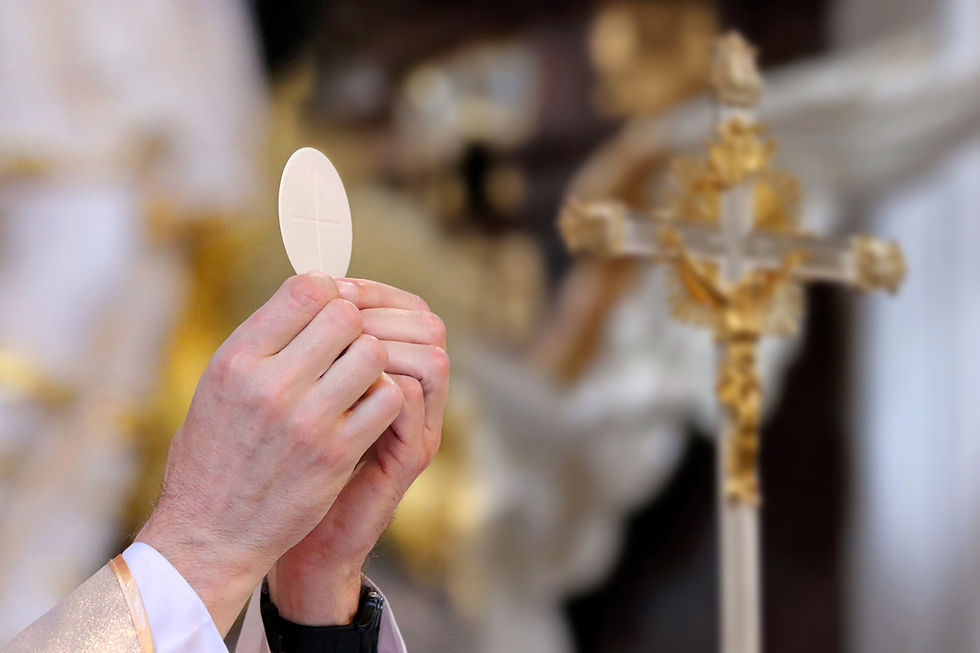

Both Catholics and Protestants celebrate the Lord's Supper by partaking in communion, breaking bread, and drinking wine or juice. However, both groups differ on how they interpret the verses below.
What the Bible says about the first Lord's Supper
On the night he was betrayed, Jesus was eating the annual Passover meal with his twelve disciples when he instituted the Lord's Supper.
And when He had taken some bread and given thanks, He broke it and gave it to them, saying, "This is My body which is given for you; do this in remembrance of Me." And in the same way He took the cup after they had eaten, saying, "This cup which is poured out for you is the new covenant in My blood" (Luke 22:19-20).
Catholic Transubstantiation — "Real" flesh and blood of Jesus
Catholics believe the bread and wine at communion are transformed into the actual body, blood, soul, and divinity of Jesus Christ, called transubstantiation. It's real. It's not symbolic. The bread and wine are transformed when the priest repeats Jesus' words from the Last Supper.
Eucharist consists of Transubstantiation plus Communion
The Eucharist consists of two main parts. The first part is the "transubstantiation" of the bread and wine by the priest. Then, the people share in holy "communion" by eating the wafer and drinking the wine.
Protestants believe the bread and wine are "Symbols"
The bread and wine (or juice) are symbols of Jesus' body and blood, not literally his flesh and blood. At Jesus' last Passover meal, all the foods eaten were symbols of the Israelites' bondage and escape from Egypt. For example, the unleavened bread symbolized their hasty departure, as there was no time for the dough to rise. The bitter herbs they ate symbolized their bitter conditions of slavery in Egypt.
Likewise, Jesus' words of his flesh and blood at this symbolic Passover meal are taken symbolically by Protestants. Jesus reinterpreted the symbolism of the Passover lamb, bread, and wine to point to his own upcoming sacrifice as the Lamb of God on the cross for ultimate redemption. He changed the symbolism of freedom from bondage in Egypt to freedom from sin.
Did Jesus ever use symbolic language? Yes.
Jesus said he was the true vine. Was he a literal vine? No.
Jesus also said he was a door. Was he a wooden door with hinges and knobs? No.
Jesus was speaking symbolically at the Last Supper about the elements of communion. It was not his literal body and blood.
Christ's re-sacrifice at Mass vs. Protestant "once and for all time"
Catholics believe that the propitiatory sacrifice of the Mass is the very same sacrifice as that of Jesus on Calvary. The difference is that transubstantiation is not bloody, but it's still Jesus' real flesh and blood. Catholics like to call it a re-presentation rather than a re-sacrifice.
Protestants believe Christ does not need to be repetitively re-sacrificed (or re-presented) at Mass since Christ's death was one final sacrifice for all time. The Old Covenant of animal sacrifices to cover over sins was eliminated when Jesus was crucified and the temple's curtain was torn from top to bottom.
"Every priest stands daily ministering and offering time after time the same sacrifices, which can never take away sins; but He, having offered one sacrifice for sins for all time, sat down at the right hand of God" (Heb. 10:11-12).
The definitive "one sacrifice for sins for all time" of Christ on the cross stands in stark contrast to the repetitive Catholic re-presentation of that sacrifice during the Mass.
Priests giving communion vs. Protestant pastors or others
Catholics believe only priests can distribute communion. These priests must come from a long line of succession traced back to the apostles.
Protestants vary in who can administer communion, depending on the denomination, ranging from ordained ministers to elders to deacons and sometimes to laypersons.
What are indulgences, and are they biblical?
-
Catholics — indulgences reduce punishment in purgatory
-
Protestants don't believe in indulgences or purgatory

Catholics who commit venial (minor) sins will end up in purgatory for punishment of those sins before entering heaven. However, the church can reduce the punishment in purgatory by offering indulgences to people.
During the late Middle Ages and Renaissance, Pope Leo X offered indulgences for money (almsgiving) to fund the rebuilding of St. Peter's Basilica in Rome. Exploiting money through indulgences ultimately led to the Protestant Reformation. Pope Pius V officially outlawed the "exchange of money" for indulgences in 1567.
Many Catholics don't like to talk about indulgences due to their bad reputation, or they believe they no longer exist. However, "works-based" indulgences still exist today as a way to perform penance to reduce the temporary punishment in purgatory, as mentioned in the Catholic Church Catechisms 1471-1479.
"An indulgence is a remission before God of the temporal punishment due to sins whose guilt has already been forgiven..." (CCC 1471).
What are examples of Catholic indulgences?
If someone commits a sin like gossiping or littering, then they would need to perform an act (called a "penance") to reduce their punishment in purgatory.
Penance examples to obtain an indulgence
-
Making the sign of the cross
-
Abstaining from something you enjoy for a day
-
Spending time in mental prayers
-
Reading scripture
-
Reciting the Rosary
-
Adoring the Eucharistic
-
Visiting stations of the Cross
Acts of penance are determined by the Pope and the Church.
If one wanted to completely eliminate their punishment in purgatory for one sin, then they would need to confess to a priest, receive communion, pray for the Pope, and become completely detached from all sin, even venial sin.
Your Act + Treasury of Merit = A Partial Indulgence
Your act of penance (earned by your actions) is combined with an additional remission from the Church's Treasury of Merit to create an indulgence. This spiritual remission of temporal punishment in purgatory comes from the Treasury of Merit stored up in heaven from the prayers and good works of Christ, Mary, and the saints.
The partial indulgence is instantly dispensed when a baptized Catholic person performs an act of penance with a sincere heart, with the general intention to gain an indulgence, and is without any unconfessed mortal sin.
Protestants don't believe in indulgences or purgatory
There are no biblical examples of church leaders granting indulgences to reduce punishment in purgatory. Protestants refer to a key verse in the Bible to refute indulgences where Paul says we aren't condemned for our sin.
"Therefore there is now no condemnation for those who are in Christ Jesus" (Rom. 8:1).
Christ paid it all on the cross. There is no spiritual debt to pay.
Catholics pray to Mary — is it biblical?
-
Catholics say yes
-
Protestants say no


Catholic beliefs on prayers to Mary
The Catholic Church teaches you should pray to the Father but also direct your prayers to Mary, the mother of Jesus.
In the Catechism it says
"When we pray to her [Mary], we are adhering with her to the plan of the Father, who sends his Son to save all men." . . . "We can pray with and to her." (CCC 2679).
The Catholic Rosary has 53 prayers to Mary
Catholics pray the 'Our Father' prayer within the Rosary, but they also recite the 'Hail Mary' prayer 53 times.
The Hail Mary is directed to Mary
"Hail Mary, full of grace..." and it includes asking Mary to intercede for us when it says, "pray for us sinners."
Mary's prayers will deliver us from death, per Catholics
As an example of how highly Catholics esteem Mary, a Catechism states that souls will be delivered from death by Mary’s prayers.
"You conceived the living God and, by your prayers, will deliver our souls from death" (CCC 966).
Is Mary worshipped or venerated (highly honored)?
Catholics say they do not worship Mary since worship is for God alone. Instead, they claim to venerate her, which means to give her high honors since they revere her as the greatest of all human saints.
However, many Catholics bow down, kneel, and kiss statues of Mary. They also pray to her repetitively when they say the rosary. These actions appear to be a worship of a human, which is forbidden by the Ten Commandments.
“You shall not make for yourself a carved image, or any likeness of anything that is in heaven above, or that is in the earth beneath, or that is in the water under the earth. You shall not bow down to them or serve them, for I the Lord your God am a jealous God” (Exodus 20:4-5).
Protestant beliefs on prayers to Mary
Nowhere in the Bible are prayers directed to Mary or other deceased saints.
Jesus is the only mediator between God and man
Paul clearly states no one else replaces Jesus Christ as the mediator. Mary is not a mediator.
"For there is one God, and one mediator also between God and men, the man Christ Jesus" (1 Tim. 2:5)
Apostles were not allowed to worship angels
After an angel gave John a revelation, John wanted to worship him. But the angel refused and directed him to worship God. Following this biblical example, no one should fall to their feet to venerate (or worship) Mary.
John tells us what the angel said to him:
Then I fell at his feet to worship him. But he said to me, "Do not do that; I am a fellow servant of yours and your brethren who hold the testimony of Jesus; worship God" (Rev. 19:10)
Man was not allowed to worship another man (apostle)
Cornelius saw a vision of an angel that told him to send for Simon Peter to come visit him. When Peter arrived, Cornelius wanted to worship Peter, but Peter refused. Cornelius being told not to worship him is an example that human beings, even apostles, are not worthy of worship. Only God is worthy of worship.
When Peter entered, Cornelius met him, and fell at his feet and worshiped him. But Peter raised him up, saying, "Stand up; I too am just a man." (Acts 10:25-26).
We are to pray to the Father in Jesus' name
The Bible never mentions praying to Mary or saints in heaven. Instead, we are directed to pray to God the Father in Jesus' name.
"But when you pray . . . pray to your Father" (Matt 6:6).
"Pray then like this: 'Our Father in heaven'" (Matt 6:9).
"If you ask me anything in my name, I will do it" (John 14:14).
Having living people on earth to pray for us is biblical
The Bible says to pray for "living" people, but not to "dead" people. For example, Paul prayed for his living friends.
"I do not cease to give thanks for you, remembering you in my prayers" (Eph. 1:16)
Asking dead saints to pray for us is an abominable practice
In fact, the Bible strongly condemns anyone who tries to speak to the dead and lumps them in with practices of divination, witchcraft, or sorcery.
"There shall not be found among you anyone who" . . . "inquires of the dead, for whoever does these things is an abomination to the Lord" (Deut. 18:10-12)
Intercession: Mary and the saints vs. Jesus and the Holy Spirit
The Bible never mentions Mary or any saints in heaven praying for or interceding for anyone on earth.
The Bible only mentions Jesus Christ and the Holy Spirit as intercessors.
Jesus Christ intercedes for us
"Christ Jesus . . . is at the right hand of God and is also interceding for us" (Rom. 8:24).
The Holy Spirit intercedes for us
"For we do not know what to pray for as we ought, but the Spirit himself intercedes for us with groanings too deep for words" (Rom. 8:26).
Jesus is the only mediator, not Mary or the saints
"For there is one God, and one mediator also between God and men, the man Christ Jesus" (1 Tim. 2:5).
For Protestants, praying to Mary or deceased saints is entirely unbiblical. Instead, the standard biblical pattern is to pray to God the Father, in the name of Jesus, and under the guidance of the Holy Spirit.
Catholics say Mary was sinless her whole life — is it biblical?
-
Catholics believe Mary and Jesus were sinless
-
Protestants believe only Jesus was sinless
The Immaculate Conception of Mary
Catholics teach that Mary never sinned during her whole life. And she was free from original sin the moment she was conceived (by normal means) in her mother's womb. This is called the Immaculate Conception of Mary, and it is mentioned in the Catholic Catechism below.
"Mary benefited first of all and uniquely from Christ's victory over sin: she was preserved from all stain of original sin and by a special grace of God committed no sin of any kind during her whole earthly life." (CCC 411).
People mistakenly think the Immaculate Conception refers to the miraculous conception of Jesus, when in reality it was the conception of Mary in her mother's womb.
The Immaculate Conception was declared official Catholic doctrine by Pope Pius IX in 1854.
". . .from the first instant of her conception, she was totally preserved from the stain of original sin and she remained pure from all personal sin throughout her life" (CCC 508).
Catholics say Mary was sinless her whole life
One verse Catholics use to support the belief that Mary was sinless comes from the angel Gabriel's appearance to her.
"And he came to her and said, 'Greetings, O favored one, the Lord is with you!'" (Luke 1:28)
Since the Greek word for "favored" also means "to make graceful," Catholics interpret it to mean that Mary possessed a superabundance of grace, keeping her sinless. Furthermore, because they believe she was born without a sin nature, she was able to remain free from sin her entire life.
Here's another verse Catholics use for Mary's sinlessness. Mary's relative, Elizabeth, who was six months pregnant with John the Baptist, cried out that Mary was blessed.
"When Elizabeth heard Mary's greeting, the baby leaped in her womb; and Elizabeth was filled with the Holy Spirit. And she cried out with a loud voice and said, Blessed are you among women, and blessed is the fruit of your womb! (Luke 1:41-42).
However, nothing in the Greek word translated as 'blessed' implies holiness or sinlessness. If 'blessed' meant sinless, then all the blessed people Jesus mentions in Matthew 25:34 would also have been immaculately conceived and free from sin.
Catholics admit that no Bible verses explicitly prove Mary's Immaculate Conception. However, they believe this doctrine must be accepted because it was officially declared by the infallible teaching authority of the Roman Catholic Church. This practice of importing meanings into words like "favored" or "blessed" is ripe for abuse—as history has shown with practices like the sale of indulgences.
Was Mary the sinless mediator and the cause of salvation?
The Catholic Catechism says yes.
"...without a single sin to restrain her, she gave herself entirely to the person and to the work of her Son" . . . "Being obedient she became the cause of salvation for herself and for the whole human race" (CCC 494).
Protestants say Jesus was the only sinless human
The Bible is abundantly clear that Jesus was without sin.
Jesus "knew no sin" (2 Corinthians 5:21).
"In him there is no sin" (1 John 3:5).
The Bible says all have sinned—and that includes Mary
Scripture does not make an exception for her. To claim otherwise is to make God out to be a liar.
As the Apostle Paul wrote:
"For all have sinned and fall short of the glory of God" (Romans 3:23).
"If we say we have not sinned, we make him a liar, and his word is not in us" (1 John 1:10).
Mary acknowledges God as her Savior in her song of praise (The Magnificat). She would not have needed a Savior if she were sinless.
As she declared:
"My spirit rejoices in God my Savior" (Luke 1:47).
Protestant views summarized
The Bible never explicitly mentions Mary’s own conception.
Scripture never states that she was born without a sin nature, nor does it present her as a sinless mediator. In fact, by her own words, she referred to God as her Savior.
Mary was a normal human being sovereignly chosen by God for an extraordinary role. While she was undoubtedly a godly, favored woman and a blessed mother, those honors did not make her sinless.
Catholics say Mary was a virgin her whole life — is this biblical?
Protestants disagree since Mary had children
The Catholic Position on Mary's Lifelong Virginity
The Catholic Church officially teaches that Mary remained a virgin her entire life—before, during, and after the birth of Jesus.
Despite her marriage to Joseph, Catholic doctrine maintains that they never engaged in sexual relations.
Why do Catholics teach this? It stems from their view of Mary's exalted role. As the "Queen of Heaven" whose womb held the physical Incarnation of God, the Church teaches that a normal marital relationship would have been unfitting for her unique, holy status.
Catholic Catechism formally states Mary as the "Ever-Virgin"
The deepening of faith in the virginal motherhood led the Church to confess Mary's real and perpetual virginity even in the act of giving birth to the Son of God made man. In fact, Christ's birth "did not diminish his mother's virginal integrity but sanctified it." And so the liturgy of the Church celebrates Mary as Aeiparthenos, the "Ever-virgin". (CCC 499).
Mary "remained a virgin in conceiving her Son, a virgin in giving birth to him, a virgin in carrying him, a virgin in nursing him at her breast, always a virgin" (CCC 510).
The Protestant Counter-Argument
The Bible never implies that intimacy within marriage is unscriptural. On the contrary, God designed it as a blessing.
From the very beginning, God commanded humanity to be fruitful:
“Be fruitful and multiply and fill the earth” (Genesis 1:28).
Furthermore, in ancient Jewish culture, a woman having many children was viewed as a profound blessing from God, not a spiritual compromise.
If Mary had permanently withheld herself sexually from Joseph, she would have been violating biblical commands. The Apostle Paul explicitly taught that married couples must not deprive one another intimately:
“The husband should give to his wife her conjugal rights, and likewise the wife to her husband. For the wife does not have authority over her own body, but the husband does. Likewise the husband does not have authority over his own body, but the wife does. Do not deprive one another, except perhaps by agreement for a limited time, that you may devote yourselves to prayer; but then come together again, so that Satan may not tempt you because of your lack of self-control” (1 Cor. 7:3-5)
Protestants Believe Mary Consummated Her Marriage with Joseph
The Bible says that Joseph did not have sexual relations with Mary "until" she gave birth to Jesus. A plain reading of the verses below naturally assumes that after Jesus' birth, they began a normal marital relationship.
"And Joseph awoke from his sleep and did as the angel of the Lord commanded him, and took Mary as his wife, but kept her a virgin until she gave birth to a Son; and he called His name Jesus" (Matt. 1:24-25)
Despite the straightforward wording of this passage, Catholics interpret the word "until" differently to support their position. They argue the verse strictly addresses the time frame up to the birth of Christ and says nothing about their relationship afterward.
What About Jesus Having Brothers and Sisters?
Protestants point to verses stating that Jesus had siblings as clear evidence that Mary and Joseph consummated their marriage.
When Jesus returned to His hometown, the local crowd explicitly named His immediate family:
"Is not this the carpenter's son? Is not His mother called Mary, and His brothers, James and Joseph and Simon and Judas? And His sisters, are they not all with us?" (Matthew 13:55-56).
The Catholic Counter-Argument
Catholics counter this by stating these "brothers" were actually sons of a different Mary, or perhaps Joseph's children from a previous marriage (Catechism 500). They argue that the Greek word for brother (adelphos) can broadly refer to cousins or step-siblings.
However, Jesus' brothers are identified alongside Him nine times in the Gospels and once in Acts. Not once is the specific Greek word for cousin (anepsios) used in these passages.
The Plain Context of Scripture
The plain context of Matthew 13 shows Jesus teaching in His hometown synagogue in Nazareth. The astonished crowd connected Jesus to His identity based on His household—not through distant relatives or a different Mary.
Because the crowd grouped together the carpenter (Joseph), Mary, Jesus, and His brothers and sisters, it stretches the text to claim the crowd identified Jesus' parents, then randomly skipped to listing his cousins by name.
But the plain context is that Jesus came back to his hometown of Nazareth and was teaching in their synagogue, and he astonished them with his wisdom. Then, the people made the connection of who Jesus was. Not by his cousins, and not by another Mary, but by his family, who all still lived in Nazareth.
Where Were the Step-Siblings?
Furthermore, if Joseph had four sons and at least two daughters from a previous marriage, their absence in the biblical narrative raises major questions.
Why is there no mention of these six children when Mary and Joseph traveled to Bethlehem for the census? Why are they missing when the family escaped to Egypt to flee King Herod? Joseph certainly would not have abandoned his other children.
Conclusion
Insisting that Mary remained a perpetual virgin, or that Jesus’ siblings were merely cousins, forces the Bible to say something it simply does not. Protestants maintain that there is no reason to create binding church dogmas built on such scant scriptural evidence.
Catholics say Mary was assumed up to heaven — is it biblical?
Was Mary so holy that she was taken up to heaven at the end of her life — Assumption of Mary?

Image credit: Assumption of Mary, Rubens, circa 1626
What is the Assumption of Mary?
The Catholic Church teaches that Mary's body and soul were taken up into heaven at the end of her life. Church doctrine does not specify whether she died first and was immediately taken to heaven, or if she was taken while still alive. In either case, Catholics believe her body was spared from rotting in a grave.
This sets her apart from other believers, whose souls go to heaven while their bodies remain in the grave until their physical bodies are resurrected at the end of the age.
In 1950, Pope Pius XII formally declared the Assumption of Mary as an official dogma of the Roman Catholic Church.
"Hence the revered Mother of God, from all eternity joined in a hidden way with Jesus Christ in one and the same decree of predestination, immaculate in her conception, a most perfect virgin in her divine motherhood, the noble associate of the divine Redeemer who has won a complete triumph over sin and its consequences, finally obtained, as the supreme culmination of her privileges, that she should be preserved free from the corruption of the tomb and that, like her own Son, having overcome death, she might be taken up body and soul to the glory of heaven where, as Queen, she sits in splendor at the right hand of her Son, the immortal King of the Ages. (Munificentissimus Deus, Paragraph 40).
Catholics are required to believe in the Assumption of Mary
Because this doctrine is defined as a dogma, it is considered unchangeable and permanently binding. Willfully denying or doubting this teaching separates a person from the Catholic Church.
"Hence if anyone, which God forbid, should dare willfully to deny or to call into doubt that which we have defined, let him know that he has fallen away completely from the divine and Catholic Faith." (Munificentissimus Deus, Paragraph 45).
Are there examples of anyone taken up to heaven in the Bible?
The Bible does not mention Mary being taken up to heaven, but it does record other people who were. Scripture names two individuals who were taken directly to heaven by God without experiencing death: Enoch and Elijah.
-
Enoch: "Enoch walked with God; and he was not, for God took him" (Genesis 5:24).
-
Elijah: "As they [Elisha and Elijah] were going along and talking, behold, there appeared a chariot of fire and horses of fire which separated the two of them. And Elijah went up by a whirlwind to heaven" (2 Kings 2:11).
Because God did this for Enoch and Elijah, Catholics believe a similar miracle is entirely possible for Mary.
However, the Bible is completely silent about the end of Mary's life. It does not mention her death, her health, or where she lived out her final days.
In fact, the last time Mary appears in the Bible, she is simply praying with Jesus' disciples shortly after his ascension:
"These all with one mind were continually devoting themselves to prayer, along with the women, and Mary the mother of Jesus, and with His brothers" (Acts 1:14).
The Catholic Perspective — Church Dogma
Catholics believe the primary reason for the Assumption is Mary's sinless nature, which stems from her Immaculate Conception. Because she was free from original sin and all other sin, Catholics believe her body was spared from the physical decay that resulted from the fall of man. Mary is elevated to the highest level of any created being—a higher level than all the saints and angels.
The Assumption of Mary reflects her unique role as the Mother of Jesus and is a key reason why she is deeply venerated. The Catholic Church celebrates this holy day every year on August 15th.
The Protestant Perspective — Pure Speculation
Protestants view the Assumption as pure speculation because the Bible is completely silent on how Mary's life ended. They argue that without scriptural evidence, there is no biblical basis to claim her body and soul were taken to heaven.
From a Protestant viewpoint, creating a mandatory dogma about Mary's physical resurrection places human tradition on the same level of authority as the Bible.
Supreme authority differs substantially between Catholics and Protestants
Catholics:
1. Pope and Bishops
2. Scripture
3. Tradition
Protestants:
1. Scripture
Catholic Magisterium (pope and bishops)
Catholics believe that the Magisterium, Scripture, and Tradition are connected and interdependent upon each other. The pope is called the Bishop of Rome or the Roman Pontiff, and he is a successor to Peter.
Only the pope and bishops can authentically interpret scripture
The Roman Catholic Church Catechism says,
“The task of giving an authentic interpretation of the Word of God . . . has been entrusted to the bishops in communion with the successor of Peter, the Bishop of Rome" (CCC 85).
The pope and bishops have delegated authority from Christ
The Catholic Catechism says,
The Roman Pontiff and the bishops are "authentic teachers, that is, teachers endowed with the authority of Christ . . .” (CCC 2034).
The pope and bishops are infallible
The Catholic Catechism says,
"The supreme degree of participation in the authority of Christ is ensured by the charism of infallibility" (CCC 2035).
The pope, when he "speaks from the chair" (ex cathedra), defines an infallible teaching that faithfully interprets and defends the word of God.
Catholics have seven extra books in their Old Testament
Catholics include seven extra books in the Old Testament, such as Tobit and Maccabees, along with extra text added to Daniel and Esther that is not in the Protestant Bible. These extra books add doctrines such as purgatory, prayers for the dead, and giving food or money to the poor to wipe away sins.
Protestants hold to Sola Scriptura—scripture alone—as the preeminent authority
Under this principle, Scripture is held above church leadership, including pastors and elders. No leader can reinterpret Scripture or add to it.
For example, the Bereans were commended for searching the Scriptures to see if the teachings of Paul and Silas matched what the word of God said. Scripture was their ultimate authority, not Paul.
As Acts 17:11 states,
"...for they received the word with great eagerness, examining the Scriptures daily to see whether these things were so."
Protestants anchor their absolute authority in Scripture alone, recognizing the Bible as the definitive, God-breathed, and infallible word of God.
This is not a modern invention; it is the exact model left by Christ. Throughout the New Testament, Jesus and the apostles consistently pointed people back to the text to validate their teachings. In fact, they challenged listeners with variations of the question, "Have you not read?" over 60 times.
"Have you not even read this Scripture...?" (Mark 12:10).
For Protestants, if Christ Himself deferred to the authority of the written word, we must do the same.
Consequently, Protestants firmly reject the Catholic elevation of church hierarchy over biblical text. Catholics claim the pope and bishops are the only authentic interpreters of Scripture. Furthermore, the doctrine of papal infallibility when speaking ex cathedra, unscripturally separates believers from the text.
Ultimate authority belongs to the word of God, not to human institutions.
Tradition for Catholics
For Catholics, Sacred Tradition is divinely inspired truth handed down over the centuries that is not explicitly spelled out in the Bible. Over time, these traditions can be defined as official church dogma.
Examples include dogmas declared in modern history, such as the Immaculate Conception of Mary in 1854 and her Bodily Assumption in 1950.
Those who deliberately refuse to believe a defined dogma are considered heretics and can face excommunication.
The Magisterium—the teaching authority of the Church—brings Tradition and Scripture together to interpret them as a single deposit of faith. As the Catechism of the Catholic Church states:
"Sacred Tradition and Sacred Scripture, then, are bound closely together, and communicate one with the other. For both of them, flowing out from the same divine well-spring, come together in some fashion to form one thing, and move towards the same goal" (CCC 80).
Catholics give equal weight to Tradition and Scripture, basing this practice on several verses.
"So then brethren, stand firm and hold to the traditions which you were taught, whether by word of mouth or by letter from us" (2 Thessalonians 2:15).
Tradition for Protestants
Protestants argue that the verse above ("hold to the traditions") does not refer to church traditions handed down during or after the fourth century.
Instead, it refers specifically to the apostolic teachings that Paul himself taught and delivered to them, whether orally or in writing.
In fact, Jesus rebuked the Pharisees when they accused His disciples of breaking traditions. In this exchange, Jesus explicitly placed the word of God above human tradition:
"Why do you yourselves transgress the commandment of God for the sake of your tradition?" (Matthew 15:3).
Today, Protestants frequently practice localized traditions. For instance, one denomination may sing traditional hymns while another prefers contemporary worship. Likewise, some churches partake in communion weekly, while others do so quarterly. However, these traditions are never elevated to the level of divine Scripture since they typically deal with matters or timing not explicitly specified in the Bible.
Catholics handle tradition very differently. Over centuries, Catholic tradition developed beliefs that Mary was entirely sinless and was bodily assumed into heaven. Catholic leadership eventually formalized these views into mandatory church dogma, effectively elevating human traditions to an authority equal to God's Word. This was done despite a profound reality: the Bible is completely silent on these subjects.
Protestant views on authority summarized
1. Church leaders and pastors are reliable authorities only insofar as their teachings align with Scripture.
2. Church traditions hold value only if they align with Scripture.
3. Scripture alone (Sola Scriptura) serves as the final, infallible authority for all Christian doctrine.
The Vatican says, if you deny Peter as the first pope, you are accursed
Peter is the first in a long line of popes

“Anathema” Definition: “Accursed”
The term "anathema" means "accursed" or condemned. It indicates that anyone who denies an official Catholic doctrine is considered to be completely outside the Catholic faith—essentially labeling that person a heretic.
Catholics: Peter Holds Authority Over All Apostles and the Church
During the First Vatican Council in 1870, Catholic leadership declared that anyone who denies Peter had true authority over all the apostles and the Church is accursed. This decree explicitly rejects the idea that Peter’s primacy was merely honorary, affirming instead that his office carried absolute, direct authority.
The council stated:
"Therefore, if anyone says that blessed Peter the apostle was not appointed by Christ the lord as prince of all the apostles and visible head of the whole church militant; or that it was a primacy of honour only and not one of true and proper jurisdiction... let him be anathema."
— First Vatican Council (1870), Session 4, Chapter 1
Catholics: Peter's Power Continues Through His Successor Popes
The Catholic Church decrees a formal curse (anathema) on anyone who denies that Peter has perpetual successors over the entire Church, or denies that these successors are the Roman pontiffs (the popes).
The First Vatican Council formalized this stance:
"Therefore, if anyone says that it is not by the institution of Christ the lord himself (that is to say, by divine law) that blessed Peter should have perpetual successors in the primacy over the whole church; or that the Roman pontiff is not the successor of blessed Peter in this primacy: let him be anathema."
— First Vatican Council (1870), Session 4, Chapter 2
Protestants: Apostleship Ended with the Twelve, and Peter Could Not Transfer It
The office of an apostle was temporary by design. To qualify as a true apostle, an individual had to meet three strict criteria:
-
Accompany Jesus throughout His entire earthly ministry.
-
Witness Jesus firsthand after His resurrection.
-
Be appointed directly by the Lord Jesus Himself.
We see this standard clearly when Judas died. The remaining apostles did not choose just anyone; they sought someone who had been an eyewitness to Jesus’ ministry from the very beginning.
Peter explicitly outlined these requirements:
"'Therefore it is necessary that of the men who have accompanied us all the time that the Lord Jesus went in and out among us—beginning with the baptism of John until the day that He was taken up from us—one of these must become a witness with us of His resurrection.' . . . And they drew lots for them, and the lot fell to Matthias; and he was added to the eleven apostles." (Acts 1:21-22, 26).
Because the office required these historic milestones, it was impossible for later popes to succeed Peter. Peter’s role was unique. No modern pope can meet the baseline qualifications of walking with Jesus during His earthly ministry or seeing Him after His resurrection.
Furthermore, scripture teaches that the foundation of the Church is already complete, meaning no future apostles are needed. The only historical exception was Paul. Yet even Paul fits the rule, as he was called directly by the resurrected Jesus on the road to Damascus.
"Paul, an apostle (not sent from men nor through the agency of man, but through Jesus Christ and God the Father, who raised Him from the dead). . ." (Galatians 1:1).
Additionally, there is absolutely nothing in Scripture to suggest that Peter’s unique apostolic authority could be transferred to successors.
Protestants: The Concept of Successor Popes Emerged Centuries After Peter
Historical evidence suggests that the office of the papacy was not a part of the early Church, but rather a late political development of the Roman Empire. In fact, many historians point to Gregory the Great in 590 AD as the first legitimate medieval pope.
Because intense Roman persecutions left a massive gap in early historical records, the later Church retroactively reconstructed a lineage. They went back through time to identify early Christian leaders, labeling them as "bishops" who supposedly succeeded Peter. However, historical reality shows these early leaders were localized pastors who possessed no universal ruling power.
The concept of a centralized, politically dominant pope did not exist at the beginning of Christianity. Instead, it developed slowly between the 5th and 13th centuries as a human institution, rather than a divine decree.
Protestants: Elevating the Pope to Supreme Authority is Not Scriptural
The Bible nowhere supports elevating a single man to supreme spiritual authority. Because of this, Protestants firmly reject the core titles and powers claimed by the papacy:
-
The Titles: Scripture forbids giving a human leader titles like "Vicar of Christ" or "Holy Father."
-
Infallibility: No man can claim absolute infallibility when speaking "from the chair" (ex cathedra) on matters of doctrine or morals.
-
Indulgences: A pope does not possess the power to dispense spiritual merit or grant indulgences to reduce a soul's punishment in purgatory.
None of these dogmas are found in the written Word of God. For Protestants, these are human traditions that directly contradict the true gospel of grace.
Protestants: The Bible Has No Mechanism for Papal Succession
The Bible provides absolutely no instructions or criteria for transferring a papal office.
Furthermore, Scripture never suggests that Christ intended to establish a universal monarch over all Christians. For Protestants, this total absence of biblical guidelines proves that the papacy is a human institution rather than a divine design.
If God intended a supreme ruler for the global Church, the New Testament would outline how to choose one.
Protestants: Elders Lead, Never a Singular Leader
Instead of a centralized pope, the New Testament establishes a model of shared leadership. Protestant churches are led by a plurality of elders—a team of qualified leaders who collectively oversee the congregation, preach, and teach.
The New Testament contains detailed qualifications for these local church leaders, such as elders, overseers, and deacons. Yet, there is never any mention of a local church ruled by a single pastor who oversees everything.
Plurality is the biblical norm:
"The elders [plural] who rule well are to be considered worthy of double honor, especially those who work hard at preaching and teaching" (1 Timothy 5:17).
Paul explicitly called the elders in Ephesus to serve collectively as overseers of the church, which he referred to as the “flock.”
"Be on guard for yourselves and for all the flock, among which the Holy Spirit has made you overseers [plural], to shepherd the church of God" (Acts 20:28).
In summary, Protestants do not believe the Bible grants supreme authority to Peter, successor popes, or any single leader. Instead, Scripture places local church authority in a plural leadership of elders and overseers, rather than a singular office like the papacy.
Reasons why Peter was not the first pope and why there are no popes in the Bible
Christ is the head of the church, not Peter
Peter was a very prominent apostle in the Bible, but nowhere in the Bible does it ever use the word "pope" or "supreme leader" or attribute similar titles to Peter. The foundation of the church and future thrones in heaven only point to Jesus as supreme in authority, and all the apostles have equal positions.
Christ is the foundation of the church, not Peter
The Bible says that Jesus Christ is the sole foundation of the church and not a man.
"For no man can lay a foundation other than the one which is laid, which is Jesus Christ" (1 Corinthians 3:11).
Christ is the cornerstone of the foundation of the church, not Peter
When constructing a building, the cornerstone is the first foundation stone that sets the boundary and angle of all other foundation stones next to it and the walls above it. If it tilts left or right, the whole building will be crooked. Christ is that chief cornerstone, not Peter. Peter is only included in the foundation with the other apostles and prophets.
"...having been built on the foundation of the apostles and prophets, Christ Jesus Himself being the corner stone, in whom the whole building, being fitted together, is growing into a holy temple in the Lord ..." (Ephesians 2:20-21).
Christ is the head of the church, not Peter
Scripture states that Jesus Christ is the head of the church, leaving no room for an earthly pope.
"He [Jesus] is also head of the body, the church; and He is the beginning, the firstborn from the dead, so that He Himself will come to have first place in everything" (Collossians 1:18).
Catholics circumvent this verse by saying the pope is the head of the church on "earth" while Christ is the head of the church in "heaven."
There are 12 equal thrones in heaven for the original apostles, not a special one for Peter
Jesus is the only one who sits on the “glorious” throne in heaven. The apostles sit on 12 “regular” thrones. There is no mention of Peter having a better throne than the other apostles.
“And Jesus said to them, ‘Truly I say to you, that you who have followed Me, in the regeneration when the Son of Man will sit on His glorious throne, you also shall sit upon twelve thrones, judging the twelve tribes of Israel’” (Matt. 19:28).
There are 12 equal foundation stones in heaven named for the original apostles, not a special one for Peter
At the end of the age, the apostle John had a vision of the new holy city, Jerusalem, coming down out of heaven from God. The wall of the city had 12 foundation stones, each with the name of an apostle. There is no mention of Peter having a better foundation stone or a more important cornerstone compared to the other apostles.
"And the wall of the city had twelve foundation stones, and on them were the twelve names of the twelve apostles of the Lamb" (Revelation 21:14).
Equal authority was given to all the disciples to "bind and loose," not just Peter
Jesus first gives the keys to the kingdom to Peter to "bind and loose." Catholics view the keys of the kingdom as giving Peter supremacy over the other apostles and establishing him as the first pope.
Jesus said to Peter,
"I will give you the keys of the kingdom of heaven; and whatever you bind on earth shall have been bound in heaven, and whatever you loose on earth shall have been loosed in heaven" (Matthew 16:19).
However, Protestants note that two chapters later, the same powers were also given to the other disciples. Peter may have been first, but his power was similar to the others.
Jesus said to the disciples,
"Truly I say to you, whatever you bind on earth shall have been bound in heaven; and whatever you loose on earth shall have been loosed in heaven" (Matthew 18:18).
For church governance, the Bible describes church elders (plural) and never a singular leader
First-century churches were led by elders, which are also referred to as overseers or bishops. They were never led by a singular leader.
"From Miletus he sent to Ephesus and called to him the elders of the church. And when they had come to him, he said to them... 'Be on guard for yourselves and for all the flock, among which the Holy Spirit has made you overseers [or bishops], to shepherd the church of God which He purchased with His own blood'" (Acts 20:17-18, 28).
Peter himself never claimed a superior title, rank, or privilege over the other apostles
Peter was a leader, but not the head of the church
How Peter Described Himself (vs. Modern Papal Claims)
How did the Apostle Peter actually view his own role? When looking at his own writings, he never elevates himself to a position of supreme authority. Instead, his language points to equality and humility.
1. "An" Apostle, Not "The" Apostle
"Peter, an apostle of Jesus Christ" (1 Peter 1:1).
Peter introduces himself simply as "an" apostle, not "the" chief apostle or the head of the church. He claims no unique rank above the others.
2. A Fellow Elder, Not a Supreme Leader
"I exhort the elders among you, as your fellow elder" (1 Peter 5:1).
When addressing church leadership, Peter identifies as a “fellow elder.” He places himself on equal footing with local church leaders rather than claiming a superior hierarchy.
3. A Warning Against "Lording It" Over the Church
"… shepherd the flock... not for sordid gain… nor yet as lording it over those allotted to your charge" (1 Peter 5:2-3).
Peter explicitly warns leaders against abusing authority or seeking power. His focus is on humble service, not popularity, wealth, or absolute control.
4. A Servant of Christ
"Simon Peter, a bond-servant and apostle of Jesus Christ…" (2 Peter 1:1).
Peter defines his identity as a bond-servant. He views himself as a submissive worker for Christ, not an exalted ruler over Christ's church.
5. "Stand Up; I Too Am Just a Man"
"When Peter entered, Cornelius met him, and fell at his feet and worshiped him. But Peter raised him up, saying, 'Stand up; I too am just a man'" (Acts 10:25-26).
When a Roman centurion tried to bow before him, Peter immediately rebuked the action. He utterly rejected any superior spiritual rank or personal veneration.
The Bottom Line
While tradition shows the Pope allowing people to kneel before him, bow down, and kiss his ring, the biblical text reveals that Peter would have detested such treatment. Peter's own words consistently reject the very structure of the modern papacy.
Jesus and the other disciples didn’t treat Peter with pope-like superiority
Five more reasons why Peter wasn't the first pope
If Peter were truly the first pope, his closest friends and fellow disciples would have treated him like royalty. But the Bible shows Jesus and the disciples never treated Peter as if he had a superior rank.
A Shared Mission, Not a Single Monarchy
The Bible shows that Peter did not rule over the entire global church. Instead, he and Paul divided their mission fields based on geographic and cultural calling:
-
Peter was primarily sent to minister to the Jews.
-
Paul was primarily sent to minister to the Gentiles.
This division of ministry proves they had parallel apostolic jurisdictions. Peter did not hold ultimate veto power over Paul's mission.
If Peter was superior, why would the 12 disciples ask who was the greatest in the kingdom?
The disciples didn’t think Peter was the greatest in the kingdom.
". . .the disciples came to Jesus and said, 'Who then is greatest in the kingdom of heaven?'" (Matthew 18:1)
If Peter had a superior rank, this question would make absolutely no sense. The disciples clearly did not view Peter as their spiritual superior.
Jesus responded to their question by pulling a small child before them:
"Whoever then humbles himself as this child, he is the greatest in the kingdom of heaven" (Matthew 18:4).
Notice what Jesus did not do here:
-
He did not say, "Why are you asking? I already picked Peter."
-
He did not chide them for forgetting Peter's supreme authority.
The Takeaway
Why didn’t Jesus take this obvious opportunity to point to Peter? Because Peter wasn't above the rest.
Instead of setting up a top-down religious hierarchy, Jesus flipped their view of power upside down. He taught that true greatness means becoming a servant to everyone—the exact opposite of a supreme earthly throne.
If Peter was superior, why would James and John ask to sit in a place of honor on the left and right of Jesus in glory?
If Jesus had already established Peter as the supreme leader of the Church, the behavior of the other disciples would have been hard to explain.
A clear example of this happens when James and John approach Jesus privately, attempting to secure the highest positions of authority in His kingdom:
"James and John, the two sons of Zebedee, came up to Jesus... They said to Him, ‘Grant that we may sit, one on Your right and one on Your left, in Your glory'... Hearing this, the ten began to feel indignant with James and John" (Mark 10:35, 37, 41).
From a biblical standpoint, this bold request exposes two major flaws in the argument for papal primacy:
-
The disciples ignored Peter's supposed rank: James and John actively tried to claim the chief places of honor for themselves, showing no recognition of a unique "pope-like" office belonging to Peter.
-
The group operated as equals: When the other ten disciples found out about the request, the text says they became indignant with James and John. The tension existed because the other disciples still viewed themselves as peers on equal ground.
Jesus Rejects the Hierarchical Model
If the modern papacy were part of His design, Jesus simply could have corrected them by reaffirming Peter’s unique appointment.
Instead, Jesus completely dismantled the concept of a top-down religious hierarchy:
"... Jesus said to them... 'Whoever wishes to become great among you shall be your servant; and whoever wishes to be first among you shall be slave of all. For even the Son of Man did not come to be served, but to serve, and to give His life a ransom for many'" (Mark 10:42, 43-45).
The Takeaway
Why did Jesus completely bypass Peter's supremacy during this major debate over rank? Because Peter was never intended to be a supreme ruler. Rather than establishing an earthly spiritual monarchy, Jesus leveled the playing field and redefined leadership as humble service.
If Peter was superior, why did James preside over the Jerusalem council and not Peter?
Perhaps the strongest historical evidence against early papal primacy is the Jerusalem Council found in Acts 15. This crucial meeting took place roughly 15 to 20 years after Pentecost to decide a massive theological crisis: Did Gentile converts need to be circumcised to be saved?
If Peter were the supreme head of the global Church, he logically would have presided over this council and issued the final, binding verdict. Instead, James presided.
Peter Testified as a Witness—Not the Judge
During the debate, Paul, Barnabas, and Peter all presented their arguments. Peter spoke powerfully about how the Holy Spirit had come to the Gentiles. However, Peter spoke as a witness, not as the judge.
When the time came to officially settle the matter, it was James who took the leadership role and said the Gentiles didn’t need to be circumcised:
"Therefore it is my judgment that we do not trouble those who are turning to God from among the Gentiles..." (Acts 15:19).
James, the brother of Jesus, was the leader of the Jerusalem church and delivered the final verdict ("my judgment"), established the policy for the entire Christian world.
The Timeline Contradicts the Papacy
This council occurred decades after Peter’s famous sermon at Pentecost. At Pentecost, the Holy Spirit dynamically transformed Peter from a fearful fisherman into a bold public leader, resulting in thousands of salvations.
But as the Jerusalem Council proves, Peter's prominent role as an evangelist did not automatically elevate him into a supreme corporate ruler.
-
Peter was a pillar of the church, but he still submitted to the collective leadership of the council.
-
James acted as the regional leader and primary voice of the Jerusalem church body.
-
The decision was issued by the "apostles and elders" (Acts 15:22-23), rather than an ex-cathedra papal decree.
The Takeaway
The structure of the Jerusalem Council directly contradicts the hierarchy of a modern papacy. In the first major legal and theological crisis of the early Church, Peter did not sit on a solitary throne or exercise supreme veto power. But he was a highly respected leader among a council of peers.
If Peter was superior, why was Peter being sent by other apostles to Samaria, rather than being in charge?
Another clear indication that Peter lacked supreme authority is found in how missionary journeys were organized in the early Church.
When a new revival broke out outside of Jerusalem, the leadership council took charge:
"Now when the apostles in Jerusalem heard that Samaria had received the word of God, they sent them Peter and John..." (Acts 8:14).
If Peter were the preeminent leader—the first pope—he logically would have been the one commissioning and sending out missionaries to oversee new church plants. Instead, Peter was sent by the other apostles. This shows that Peter was a member of a leadership team, not its absolute ruler.
No Control Over the Broader Churches
This lack of singular papal authority is also evident in how the early churches were governed. Peter never exercised administrative or theological control over major churches in Corinth, Galatia, or Ephesus. Instead, Paul corrected these churches through his epistles.
The Takeaway
If Peter were the supreme leader of the Church, the narrative of Acts 8 would be inverted. Peter would have stayed at the helm in Jerusalem, dispatching others to handle the fieldwork. By acting as a sent missionary alongside John, Peter demonstrated that he viewed himself as a servant to the collective body of Christ, not its monarch.
If Peter was superior, why would Paul say he was not inferior to any apostles?
If Peter held a supreme, pope-like office over the entire global Church, then every other apostle would naturally be subordinate to him. However, the Apostle Paul explicitly rejected the idea that any leader held a superior rank over his ministry.
When addressing the church in Corinth, Paul firmly defended his independent authority:
"For I consider myself not in the least inferior to the most eminent apostles" (2 Corinthians 11:5).
The Takeaway
Paul’s refusal to take a back seat to any leader proves that the early Church recognized a brotherhood of co-equal apostles, not a top-down religious monarchy. Peter was undoubtedly influential, but according to Paul's own inspired words, Peter was not greater than his peers.
Jesus, the apostles, and Paul never viewed Peter as superior
When you look at the actual behavior of Jesus, Paul, and the rest of the apostles, a consistent pattern emerges: nobody in the New Testament treated Peter as a supreme ruler.
-
The disciples argued over who was the greatest—Jesus and the disciples never said Peter.
-
James presided over the Jerusalem Council—not Peter.
-
A council of apostles sent Peter to Samaria—not Peter sending others.
-
Paul claimed he was not inferior to any apostles—an impossible claim if Peter was superior.
The Catholic doctrine of papal primacy requires Peter to have held a uniquely elevated, sovereign position over his peers. Yet, the day-to-day actions of those who lived and served alongside him tell a completely different story.
The New Testament records a brotherhood of equals working together to expand the gospel, with Peter serving as a highly respected pillar—but never a pope.
If Peter was the first bishop ("pope") of Rome, why is there scant evidence of Peter in Rome?
Paul figured prominently in Rome, not Peter

Catholics say Peter went to Rome, pastored a church in Rome, died in Rome, and is buried in Rome. St. Peter’s Basilica is supposedly built where he was buried.
But nowhere does the Bible explicitly mention that Peter ever visited or led a church in Rome.
Paul didn’t mention Peter in his letter to the Romans
Paul wrote to 28 people in the book of Romans in the year AD 56, but Paul wasn’t mentioned.
There’s no evidence Peter pastored a church in Rome
How do we know that? If Peter was the pastor of the church in Rome, why doesn’t Paul write to or refer to Peter? It would be pretty serious to overlook Peter.
Paul mentioned others, but not Peter, while in prison in Rome when he wrote four letters
When Paul was in prison in Rome in the years 60 to 62, he wrote four letters (Ephesians, Philippians, Collossians, and Philemon). He included in those letters all who came to him, but he never mentions Peter visiting him.
In Paul’s last letter, 2 Timothy, written in the year 64 or about that, he gives a greeting to ten people in Rome—but not Peter.
Paul went to Rome, where no one else had been before, to spread the gospel
Paul went to Rome to preach.
“I aspired to preach the gospel, not where Christ was already named, so that I would not build on another man’s foundation” (Rom. 15:20).
Paul said he wouldn't go to Rome if somebody else had already established a church there. If Peter had already planted a church in Rome, then Paul’s statement would have been false.
While an argument from silence is not proof of Peter being largely absent from Rome, should Peter be elevated to the supreme authority (Pontiff of Rome) in a place where Paul was much more foundational?
Did Jesus build his church on Peter the rock?
Catholics say the church was built on Peter — the rock

The Key Verse Catholics Believe The Papacy Rests
Roman Catholics consider Jesus calling Peter the "rock" in Matthew as the foundational passage for the papacy. Here's what the verses say.
"Now when Jesus came into the district of Caesarea Philippi, He was asking His disciples, 'Who do people say that the Son of Man is?' And they said, 'Some say John the Baptist; and others, Elijah; but still others, Jeremiah, or one of the prophets.' He said to them, 'But who do you say that I am?' Simon Peter answered, 'You are the Christ, the Son of the living God.' And Jesus said to him, 'Blessed are you, Simon Barjona, because flesh and blood did not reveal this to you, but My Father who is in heaven. I also say to you that you are Peter [Greek Petros, a stone], and upon this rock [Greek petra, large rock; bed-rock] I will build My church; and the gates of Hades will not overpower it." (Matt 16:13-18).
Potential Views On The Rock The Church Is Built Upon
The metaphor for "this rock" is
-
View 1: Peter as the rock—Catholic position
-
View 2: Jesus as the rock
-
View 3: All the apostles as the rock
-
View 4: The truth of Peter’s statement, "Jesus is the Christ"
View 1: Peter As The Rock
The Catholic view is Peter would be the "bedrock" on which He would build His church. Since Peter’s name means “rock,” and Jesus is going to build His church on a rock, it appears that Christ means to link Peter with the founding of the church.
View 2: Jesus Is The Rock
In Greek, the name for Peter (petros) is described as a small stone, while the next term for rock (petra) describes a large rock bed that is more foundational. This view considers Jesus was contrasting himself with Peter; "You're the small rock, but I'm the foundation." The foundational, large rock bed (petra) is the same word used elsewhere to build your house on the rock, not sand (Matthew 7:24-25).
View 3: All The Apostles As The Rock
Jesus was addressing all the disciples when he asked a question.
"He was asking His disciples, 'Who do people say that the Son of Man is?'"
Peter spoke up first, acting as the "mouthpiece" for all the disciples. The rock would be a promise to all the apostles he was addressing, not just Peter, even though he was the first to answer.
View 4: The Truth Of Peter's Statement—"You Are The Christ"
In this view, the “rock” is the truthfulness of Peter's statement,
“You are the Christ, the son of the living God.” (vs. 16)
Jesus didn’t say upon “you” I will build my church, but said upon “this rock” I will build my church. “This rock” refers to Peter's confession of faith that Jesus is the Christ, the Son of the living God.
In context, this whole section of scripture is focused on confirming who Jesus was as can seen in the concluding verse where Jesus says don't tell anyone I am the Christ.
"Then He warned the disciples that they should tell no one that He was the Christ." (vs. 20)
The Protestant View
Protestants hold various views on "this rock" (the large rock bed), but few are willing to say they are 100% correct. Most would hold a view closer to View 4, where the rock that the church is built upon is the common confession that Jesus is the Christ, the Son of the living God.
The foundation of the church is the revelation of God given through His apostles and prophets, and Jesus is the chief cornerstone of that foundation.
“…you are fellow citizens with the saints, and are of God’s household, having been built on the foundation of the apostles and prophets, Christ Jesus Himself being the corner stone…” (Eph. 2:19-20).
God used Peter greatly in the foundation of the church. It was Peter who first proclaimed the gospel on the day of Pentecost. It was Peter who first took the gospel to the Gentiles.
However, even if you assumed View 1 is correct—that Peter is the rock the church is built upon—one can't leap to a successor pope with supreme authority. The Bible is silent on how to create a charter for the papacy, how to elect them, what their qualifications are, or anything else. Yet the Bible is clear on how to establish elders to oversee the church and their qualifications.
Protestants Look To The Holy Spirit, Not The Pope
The Holy Spirit is viewed as Christ’s true "replacement" or representative on Earth, not the Pope.
The Bible says the Holy Spirit in John 14 and 16:
-
Takes Christ's place on earth
-
Teaches Christians and leads them into truth
-
Guides Christians and enlightens their minds to truth
Protestants Say Believers On Earth Are The Priesthood
All Christians represent Jesus on Earth instead of consolidating that role into the Magisterium.
Peter, writing to believers, said,
"You also, as living stones, are being built up as a spiritual house for a holy priesthood, to offer up spiritual sacrifices acceptable to God through Jesus Christ" (1 Pet. 2:5).
Catholic Doctrine Much Later Determined Peter Was The Rock
In Vatican 1 (1870), the Catholic Church infallibly determined that Peter was the rock the church was to be built upon. And they stated that it has always been so throughout history. Those who don't believe Peter was given papal primacy are accursed.
Catholic History Has Inconsistencies On Peter As The Rock
Before Vatican 1 in the 19th century, Peter as the rock was not a consistent doctrine. Saint Augustine, in the 5th century, says he initially thought the rock was Peter but then believed it was Jesus. Then, he said he leaves it up to the reader to decide which opinion is more probable.
In the 17th century, French historian and Catholic priest Jean de Launoy surveyed patristic evidence and found:
-
17 citations supporting Peter as rock
-
16 citations supporting Christ as rock
-
8 citations supporting all apostles as the rock
-
44 citations supporting Peter's confession of faith in Jesus as the rock
(White, James R., The Roman Catholic Controversy, 1996, p. 120)
It's apparent the Roman Catholic position of Peter being the rock has not always been agreed upon. Many people left Roman Catholicism after the Vatican's interpretation of Peter being the rock and that you were accursed if you didn’t believe it.
Why is the pope not allowed to marry if Peter was married?
Forbidding marriage is unbiblical
The Bible says Peter was married
Peter was married, as can be seen when Mark recounts how Jesus went to Peter's house and healed Peter's mother-in-law, who was sick with a fever.
"And immediately after they came out of the synagogue, they came into the house of Simon [Peter] and Andrew, with James and John. Now Simon’s [Peter's] mother-in-law was lying sick with a fever; and immediately they spoke to Jesus about her. And He came to her and raised her up, taking her by the hand, and the fever left her, and she waited on them." (Mark 1:29-31).
Paul, in his argument on the use of liberty, even referenced the fact that Peter traveled with his believing wife.
"Do we not have a right to take along a believing wife, even as the rest of the apostles and the brothers of the Lord and Cephas [Peter]?" (1 Cor. 9:5).
So why are Catholic popes not allowed to marry if Peter was the first pope and he was married? Forbidding marriage is an example of adding rules or works to scripture that isn't there.
People with deceitful spirits will forbid marriage
Timothy warned the church about hypocritical false teachers who make up rules like forbidding marriage.
"But the Spirit explicitly says that in later times some will fall away from the faith, paying attention to deceitful spirits and doctrines of demons, by means of the hypocrisy of liars seared in their own conscience as with a branding iron, men who forbid marriage and advocate abstaining from foods which God has created to be gratefully shared in by those who believe and know the truth. For everything created by God is good, and nothing is to be rejected if it is received with gratitude; for it is sanctified by means of the word of God and prayer" (1 Tim 4:1-5).
Popes, priests, and bishops are not allowed to marry
Taking a vow of celibacy was introduced to prevent widespread corruption, such as popes and priests passing down church land to their children. Celibacy and forbidding marriage, or requiring separation from existing wives, became official ecclesiastical law in 1139 AD (Canon 7, 2nd Lateran Council). Church councils as early as the 4th century issued the first written law ordering bishops, priests, and deacons to completely abstain from sexual relations with their wives and stop having children.
By putting unscriptural constraints on the leadership, the Catholic Church has suffered significant lapses in morality. Unfortunately, the number of immoral popes, including those fathering illegitimate children, is rather significant. A list can be found on Wikipedia under “List of sexually active popes.”
Paul has a solution — get married if you can't control your passion
Paul says it's better to marry than to burn with passion and sin. Due to persecution of the church at the time of his writings, Paul said his preference was to be unmarried.
"But I say to the unmarried and to widows that it is good for them if they remain even as I. But if they do not have self-control, let them marry; for it is better to marry than to burn with passion" (1 Corinthians 7:8-9).
"I think then that this is good in view of the present distress, that it is good for a man to remain as he is" (1 Corinthians 7:26).
Paul says there should be no restraint on marriage
He also understands that a person who is married will have their interests divided between pleasing the Lord or their spouse. But the decision is up to the person, not church law.
"One who is unmarried is concerned about the things of the Lord, how he may please the Lord; but one who is married is concerned about the things of the world, how he may please his wife, and his interests are divided. The woman who is unmarried, and the virgin, is concerned about the things of the Lord, that she may be holy both in body and spirit; but one who is married is concerned about the things of the world, how she may please her husband. This I say for your own benefit; not to put a restraint upon you, but to promote what is appropriate and to secure undistracted devotion to the Lord." (1 Cor. 7:32-35).
The Bible says marriage is good — so don't restrain it
— Provides Companionship
"Then the Lord God said, 'It is not good for the man to be alone. I will make him a helper suitable for him" (Gen. 2:18).
— Receives Blessing
"He who finds a wife finds a good thing and obtains favor from the Lord" (Prov. 18:22).
— Held in Honor
"Marriage is to be held in honor among all" (Heb. 13:4).
By banning marriage for leadership, Catholics have changed preferences into rules. The Magisterium has added to scripture. The consequences have been enormous. If Catholics believe in a pope, he should have the freedom to marry like Peter or not to marry. After all, that was the position of the Catholic Church for many centuries.
Are Catholics and Protestants united despite their differences?
There has been a recent movement called the ECT (Evangelicals and Catholics Together) to create more unity
Catholics and Protestants have many common theological beliefs that were discussed in the first part of this article. Lately, both sides have tried to come together on societal issues that both agree on. This is a vast change from the 16th-century Reformation period, when both sides executed hundreds for heresy or treason, and millions were killed in broader religious wars.
The move toward agreement—pro-life, marriage, etc.
Both groups share similar societal beliefs. Both desire to be unified to fight abortion, promote marriage between a man and a woman, protect religious freedom, and help the poor, among other agreements.
The core area of disagreement—how someone is saved
Here's one of the statements the signers had to agree to.
"We affirm together that we are justified by grace through faith because of Christ."
One of the key disagreements is that Protestants need the word "faith" changed to "faith alone," which Catholics wouldn't agree to.
Protestants say salvation is instantaneous
Protestants believe justification is an instantaneous act (not gradual) when you believe in Jesus as your savior and God declares you righteous. At that moment, a person is saved, and all sins are forgiven.
Protestants say you then move into the next phase of spiritual life called sanctification. This is a lifelong process of trying to live a holy life. Believers were created for good works. And good works show that you were truly Justified. But Paul says you'll still sin, just like he does (Romans 7). But God doesn't condemn Paul or you for those sins (Rom. 8:1). You're still saved.
Catholics say salvation is a lifelong process
Catholics combine the initial belief in Jesus (justification) with "good works" (sanctification). Did you go to Mass? Did you lie? Did you lust?
There is no assurance of salvation since a Catholic bounces back and forth between being saved or being condemned to hell depending on their sin. After committing a mortal sin such as missing Mass, a Catholic is condemned to hell. The "good works" part of Catholicism requires the person to go to confession and perform a penance to get out of hell and move up into purgatory.
Best Bible Verse For Faith Alone
Paul says salvation is a free gift of God's grace, rather than a result of human works.
“For by grace you have been saved through faith; and that not of yourselves, it is the gift of God; not as a result of works, so that no one may boast” (Ephesians 2:8-9).
After we are saved by faith (justified), then we should do good works as a result of that faith.
“For we are His workmanship, created in Christ Jesus for good works, which God prepared beforehand so that we would walk in them” (Ephesians 2:10).
Protestants do believe in good works like the verse above says, but doing good works doesn't save someone. It may seem like a subtle difference, but it's not. Protestants have assurance of their salvation, and Catholics are never assured of their salvation.
Catholics Pronounce Anathemas on Faith Alone
So strongly does the Catholic Church come against the Protestant view of salvation by faith alone that they have pronounced an anathema (accursed) on anyone who believes it. This is the primary reason many Protestants won't sign or agree with the contents of the ECT (Evangelicals and Catholics Together) document since true salvation is at stake.
Summary of Catholic and Protestant views
Salvation—Mary—Authority—Pope
Agreements between Catholics and Protestants
-
Virgin Birth: Jesus conceived in Mary's womb by the Holy Spirit, not a human father
-
Trinity: One God, but three persons (Father, Son, Holy Spirit)
-
Deity of Christ: Christ had two natures (human and divine)
-
Sinlessness of Christ: Jesus was sinless his entire life
-
Christ was crucified: Jesus died for human sin
-
Resurrection: Christ was resurrected on the third day
-
Destiny sealed at death: No chance for salvation after death
-
Heaven and Hell: They are both eternal
-
Second Coming: Christ will return bodily from heaven
Differences between Catholics and Protestants
Salvation
Catholic view
-
Faith in Jesus, and
-
Good Works, and
-
Sacraments
Protestant view
-
Faith in Jesus alone — with good works as a result of that faith
Five Solas — Protestants vs Catholics
Protestant "alone" views — Catholics add to them
-
Grace alone — add human merit
-
Faith alone — add good works
-
Christ alone — add other mediators
-
Scripture alone — add tradition and the Pope
-
Glory to God alone — add Mary and the saints
Types of Sin
Catholic view
-
Venial Sin — a minor sin, like gossiping, sends you to purgatory, then heaven
-
Mortal Sin — a major sin, like getting drunk, sends you to hell, unless you confess the sin to a priest and perform penance
Protestant view
-
All sin condemns you — but you still go to heaven if saved; or sin sends you to hell if unsaved
Eternal Destination
Catholic view of Destinations
-
Heaven — infants who are baptized; and maybe saints and martyrs who avoid purgatory (exceedingly rare)
-
Purgatory — a temporary state if you believe in Jesus as your savior, then you go to heaven (the majority)
-
Hell — if you don't believe in Jesus; or you commit a Mortal sin and don't confess it to a priest
Protestant view of Destinations
-
Heaven — if you believe in Jesus as your savior
-
Purgatory — not in the Bible
-
Hell — if you don't believe in Jesus as your savior
Purgatory
Catholic view of Purgatory
-
Purgatory — is a state of final purification after death to burn off any leftover imperfections from sin before the soul enters heaven
-
Time in Purgatory — is unspecified (maybe hundreds, thousands, or million of years)
Protestant view of Purgatory
-
No Purgatory — all sins were already paid for by Jesus at the cross, once and for all time
Indulgences and Penance
Catholic view
-
Indulgences — reduce the punishment in purgatory due to sins whose guilt has already been forgiven through confession.
-
Penance (confession) — is an act of good works for a living or dead person that generates Indulgences. After confession to a priest, the priest determines the penance to be performed to repair harm, demonstrate sorrow, and fortify against temptation.
-
Examples of Penance
- Making the sign of the cross
- Reciting the Rosary
- Adoring the Eucharist
- Visiting stations of the cross, and many more
Protestant view
-
No Indulgences — not biblical since forgiveness comes by grace alone, not by works or merit
-
No Penance — not biblical since good works can't make up for our bad works (sin), but we still should perform good works to let our light shine and glorify God
Baptism
Catholic view of Baptism
-
Method: "sprinkling"
-
Salvation Imparted "yes" — it is the cause of salvation by washing away original sin and all prior sin up to that point
-
Baptism Timing — ideally within a few weeks after birth or later if someone joins the Catholic Church
Protestant view of Baptism
-
Method: "full-immersion"
-
Salvation Imparted "no" — it is a public proclamation of an inward change, or a sign and seal of God's covenant, not a cause of salvation, although a few denominations disagree
-
Baptism Timing — typically soon after salvation, although some denominations baptize infants
Communion and Eucharist
Catholic view of Communion
-
"Literal" Body and Blood — at the Mass a priest transforms the bread and wine into the literal body and blood of Jesus, called Transubstantiation
-
Timing — at least once a year, but typically daily or weekly
-
Who Partakes — you must be a Catholic and you must have confessed any mortal sins to a priest
-
Eucharist — combination of the priest's Transubstantiation of the bread and wine, and partaking of Holy Communion
Protestant view of Communion
-
"Symbolic" Body and Blood — the bread and wine are symbolic, not literal, of Christ's body and blood
-
Timing — weekly, monthly, quarterly, etc., but exact timing is unspecified in the Bible
-
Who Partakes — you must be a believer and not in a state of unrepentant sin
Sacraments
Catholic view of the Sacraments
The sacraments are the ordinary and necessary means to impart saving grace to believers beginning with baptism.
-
Baptism — salvation
-
Communion (Eucharist) — salvation and initiation
-
Confirmation — salvation and initiation
-
Penance (confession) — imparts grace for salvation
-
Last Rites — confession, annointing, communion
-
Holy Orders — optional if not an ordained minister
-
Matrimony — optional if remaining single
Protestant view of the Sacraments
Jesus instituted only two sacraments in the Bible, sometimes called ordinances, and they do not impart salvation.
-
Baptism
-
Communion
Mary — Pray to her?
Catholic view of Praying to Mary
-
Pray to Mary — as an example, the Rosary directs prayers to Mary in the Hail Mary over 50 times
-
Mary a Mediator — Mary is the Mediatrix, a subordinate mediator based on her unique role of giving birth to Jesus
-
Mary an Intercessor — Mary and the saints intercede for us as well as Jesus and the Holy Spirit
Protestant view of Praying to Mary
-
Pray to Mary "no" — Jesus said to pray to the Father in Jesus name; and forbids inquiring of the dead
-
Mary a Mediator "no" — the Bible says the only mediator between God and man is Jesus
-
Mary an Intercessor "no" — the Bible says only Jesus and the Holy Spirit intercede for us
Mary — Sinless? (Immaculate Conception)
Catholic view of Sinless Mary
-
Mary Original Sin "no" — she was conceived free from original sin—the Immaculate Conception
-
Mary Sinful "no" — Mary never sinned her whole life because she was blessed and favored by God
-
Salvation "not needed" — since she was sinless and permanently filled with divine grace
Protestant view of Sinless Mary
-
Mary Original Sin "yes" — she was born under the curse of original sin passed down from Adam
-
Mary Sinful "yes" — the Bible says all have sinned, and Jesus was the only sinless person
-
Salvation "needed" — she needed salvation and called Jesus "my savior"
Mary — a Perpetual Virgin?
Catholic view
-
Mary a Virgin "whole life" — she was a virgin her whole life, not just until Jesus was born
-
Sex in Marriage "no" — her husband Joseph never consummated his marriage with Mary
-
Mary's Children "none" — when the Bible refers to Mary's "sons," Catholics interpret the word "sons" as "cousins," and conclude she remained a virgin
Protestant view
-
Mary a Virgin "until Jesus' birth" — she was a virgin when the Holy Spirit conceived Jesus in her womb
-
Sex in Marriage "yes" — Joseph kept Mary a virgin until Jesus' birth, and Mary did not deprive Joseph, which scripture forbids in marriage
-
Mary's Children "at least 6" — Mary had four sons, James, Joseph, Simon, and Jude and several unnamed daughters, which implies she consummated her marriage with Joseph
Mary — Assumed up to Heaven?
Catholic view — Assumption of Mary
-
Mary's Assumption "yes" — Mary was assumed body and soul up into heaven at the end of her life, but it is unspecified whether it was before death or right after death
-
Accursed if don't agree — it became official, infallible Church dogma in 1950 and it must be believed, otherwise you have committed heresy and are accursed
-
Assumption Purpose — Mary's sinless body should not suffer decay in the grave, and the assumption gives people hope of their own future bodily resurrection into heaven
Protestant view — Assumption of Mary
-
Mary's Assumption "no" — the Bible doesn't say when, how, or where she died and was buried, which makes Mary's Assumption pure speculation relying on Catholic Tradition
-
Protestants accursed? — Catholics view Protestants or anyone as accursed (anathema) who don't believe in the Assumption of Mary
-
Assumption Purpose "none" — Protestants don't elevate Mary since the Bible doesn't say she was a perpetual virgin, or sinless her whole life, or assumed up to heaven
Authority: Pope / Scripture / Tradition
Catholic view of Authority
-
Leadership by the Pope "highest" — Catholics have created a hierarchical structure where the Magisterium (Pope and Bishops) interpret scripture and tradition. Peter was the first Pope (Roman bishop) in an unbroken line of successor Popes who have supreme authority over the church.
-
Pope is infallible — speaking from the chair (ex cathedra)
-
Scripture "lower" — scripture is below the leadership since they are the only ones to interpret it
-
Tradition "lower" — tradition is below leadership since it develops over time and may become official doctrine or dogma equal with scripture when determined by leadership
Protestant view of Authority
-
Leadership by Elders — Protestants believe in plurality of elders or overseers described in the Bible. They don't believe in a singular, supreme leader of the church. They don't believe that Peter was the first Pope, or that there are successor Popes.
-
Scripture "highest" — the highest authority rests with God-breathed, infallible Scripture, not man
-
Tradition "lower" — tradition is only what the disciples wrote down or what they passed down orally, not what later church fathers decided was tradition
Peter — the first Pope?
Catholic view of Peter as Pope
-
Peter as Pope "yes" — Catholics say Peter had supreme authority over all the other apostles and the church
-
Popes "created later" — The idea of a Pope with supreme authority came centuries after Peter
-
Pope is Dogma (1870) — The Pope's supreme authority developed over time, but became official dogma in 1870 and included papal infallibility
Protestant view of Peter as Pope
-
Peter as Pope "no" — He was an important leader, but was never given supreme authority over the church
-
Popes are "not biblical" — Nowhere does the Bible describe a supreme leader, only elders (plural)
-
Protestants Accursed? — Catholics say if you don't believe in the supreme authority of the Pope over the church, you are anathema (accursed)
Peter as Pope — Peter's View
Catholic — Peter's view of himself
Catholics rely on Jesus' statements.
-
Peter never elevated himself to a supreme authority
Protestant — Peter's view of himself
Peter never elevated himself to supreme authority like the Pope.
-
I’m just "an apostle of Jesus Christ", not “the” apostle
-
I’m just "your fellow elder" not a supreme elder
-
Peter warns fellow elders not to lord it over others
-
I’m "a bond-servant of Christ", not an exalted person
-
Peter told Cornelius, don’t bow to me, "I too am just a man"
Peter as Pope — Disciples' View
Catholic — disciples' view of Peter as Pope
A few implications can be drawn from the Bible
-
Peter was the leading disciple who preached at Pentecost
-
Peter's name is first on a list of disciples
Protestant — disciples' view of Peter as Pope
The disciples didn’t think Peter was the greatest in the kingdom.
If Peter was superior to them —
-
Why would the 12 disciples ask Jesus who was the greatest in the kingdom?
-
Why would James and John ask Jesus to sit in a place of honor on the left and right of Jesus in glory?
-
Why did James preside over the Jerusalem council and not Peter?
-
Why was Peter being sent by other apostles to Samaria, rather than being in charge?
-
Why would Paul say he was not inferior to any apostles if Peter outranked him?
Peter as Pope — Bible's View
Catholic — Bible's view of Peter as Pope
Implications are drawn from the Bible
-
Jesus named Peter as "this rock" to build his church — according to Catholic interpretations, but opinions vary
-
Jesus gave Peter the "keys to the kingdom" — to bind and loose
-
Jesus told Peter to "feed my sheep"
Protestant — Bible's view of Peter as Pope
Does the Bible elevate Peter to a supreme leader? No. The Bible says:
-
Christ is the foundation of the church — not Peter
-
Christ is the chief cornerstone of the church — not Peter
-
Christ is the head of the church — not Peter
-
There are 12 equal thrones in heaven for the original apostles — not a special one for Peter
-
There are 12 equal foundation stones in heaven named for the original apostles — not a special one for Peter
-
Equal authority was given to all the disciples to “bind and loose” — not just Peter
-
"This rock" to build the church upon — is more likely the confession of faith, "You are the Christ" by all believers
-
The Bible describes church elders (plural) — and never a singular leader
First-century churches were led by elders, who also were referred to as overseers or bishops. They were never led by a singular leader.
Evidence of Peter in Rome?
Catholic — Peter as leader of Rome
Catholics claim Peter:
-
Pastored a church in Rome
-
Died and was buried in Rome
-
Called "Bishop of Rome" or "Roman Pontiff" (the Pope)
Protestant — Peter as leader of Rome
There is scant biblical evidence of Peter ever being in Rome.
-
No visits or pastoring in Rome — the Bible never mentions Peter in Rome or pastoring a church there
-
Peter not mentioned in Romans — Paul addressed 28 people in the book of Romans, but never Peter
-
Paul said he wouldn't build on another's foundation
-
Peter never visited Paul in prison in Rome — despite Paul writing four books of the Bible from prison
-
Peter is not mentioned in Paul's last letter from Rome — to Timothy where he greets 10 people, but not Peter
-
Death of Peter and Paul — the Bible doesn't specify where or how both died, but tradition and historical evidence points to both being martyred in Rome (Peter crucified upside down; Paul beheaded)
An argument from silence in the Bible doesn't prove Peter was never in Rome, but it appears if anyone was to be elevated to a foundational, supreme leader in Rome, it would have been Paul.
Pope — Forbidden to Marry
Catholic views
-
Not allowed to marry — the pope, bishops, and priests
-
Why marriage forbidden? — to stem corruption
Protestant views
-
Peter was married — if he was the first pope, why forbid successor popes from marrying
-
Forbidding marriage is unbiblical — Timothy warned about false teachers who forbid marriage
-
Paul said get married — if you can't control your passion
-
The Bible says marriage is good — it provides companionship, receives blessings, and is held in honor
-
Leaders, if married, are to be the husband of one wife
The take-home point — follow the Bible
Watch out for those who add things to scripture
Focus on what the Bible says.
-
If the Bible says salvation is by faith alone, don't add works.
-
If the Bible doesn't say to pray to Mary, then pray to the Father like the Bible teaches.
-
If the Bible only mentions elder(s) plural as church leaders, don't elevate one person to supreme authority like the pope.
As Catholics read through their own doctrines, they may struggle to agree with a few of them. If one doesn't agree with all the dogmas of the Roman Catholic Church, then they are considered outside the church.
The gap between Catholicism and Protestantism could almost be boiled down to "faith plus works" or "faith alone." Protestants rely on the Bible, which says that we are saved by God's undeserved mercy, not by any good works we can contribute to the process.
Paul wrote that Jesus,
"Saved us, not on the basis of deeds which we have done in righteousness, but according to His mercy, by the washing of the regeneration and renewing by the Holy Spirit" (Titus 3:5).
If you have relied on your faith and your good works to get you into heaven, then consider agreeing with Jesus that you are saved according to His mercy alone. Trust in Jesus Christ as your savior, today!
You can learn more about Salvation on our Salvation page here.
Catholic Protestant Differences

Ray Comfort
33 min • Video • Text
510K views on YouTube • 2023
LivingWaters.com

Mike Gendron
64 min • Video • Text
2.1M views on YouTube • 2022
ProclaimingTheGospel.org

Mike Gendron & Costi Hinn
38 min • Video
86K views • 2022
ForTheGospel.org (on YouTube)

Explore more topics and sermons
Other Topics on this site
Creation vs Evolution – Evolution is debunked
End Times – What does the future hold; four views
Heaven & Hell – What the Bible says about them
False Teachings – Learn to identify deceptions
Salvation – Find out how to go to heaven
Evangelism – Equip yourself to share the gospel
Questions & Answers – Get answers to life's big questions
Christian Movies – Free Christian movies and Bible stories
Marriage – Marriage, divorce, remarriage, and singleness
Next Article — End Times

Discover what each view teaches about the Rapture, Tribulation, Second Coming of Christ, Millennium, Antichrist, Last Judgment, Heaven and Hell. It's complete with graphs, charts and surveys for a high-level overview of End Times.
Article • 2026 • BibleSurf.com (this site)
Copyright 2026 to images, content and text shown in this article is retained by the respective owners and has been procured from various websites, including but not limited to BibleSurf.com, Bible Content Ministries, Wikipedia Public Domain, YouTube, Wix, Vimeo and other sources.