

Heaven and Hell — top questions answered
Read short, quick answers about the afterlife all within a single article.

In This Article — click to jump down (or just scroll)
What will heaven be like?
What will hell be like?
What determines heaven or hell?
More people in heaven or hell?
Do believers go right to heaven?
Do unbelievers go right to hell?
Do babies go to heaven?
Do pets go to heaven?
What will heaven be like?
It will be a new, perfect existence with breathtaking beauty

Revelation describes God dwelling with his people in a renewed universe with a new holy city. The apostle John, in a vision of the future, said,
“Then I saw a new heaven and a new earth; for the first heaven and the first earth passed away, and there is no longer any sea” (Rev. 21:1).
John goes on to describe all the ‘no mores’ in the new heaven and earth:
-
No more sea — (may be literal, or may symbolize the removal of chaos)
-
No more tears — (instead, full of joy)
-
No more death — (instead, live forever)
-
No more mourning or crying — (sorrow disappears)
-
No more pain — (instead, physically perfect)
-
No more wickedness — (instead, righteousness)
-
No more temple — (God and Jesus are the temple)
-
No more night, sun, or moon — (God illuminates it)
-
No more curse — (earth is restored and sin is removed)
And not only is God eliminating all misery, but he's remaking the universe better when He says,
“Behold, I am making all things new” (Rev. 21:1-8, 22-25; 22:3-5).
John also saw the holy city, the new Jerusalem coming down out of heaven to the new earth. “Its radiance was like a most rare jewel,” and “the city was pure gold, like clear glass.” A river of the water of life flowed out of the throne of God, with the tree of life on either side yielding fruit every month. A full description of the new heaven and earth is found in Revelation 21 and 22.
Even the Old Testament, when describing heaven, said there will be
“gladness and joy, and sorrow and sighing shall flee away” (Isaiah 35:10).
In summary, the Bible provides just a glimpse of how extraordinarily wonderful and beautiful heaven will be.
What will hell be like?
Hell (lake of fire) is far worse than we could ever imagine

The ultimate, final destination of those who reject Christ is called the Lake of Fire.
Hell, or the Lake of Fire, is described as a place of:
-
Unquenchable fire — (Mark 9:48)
-
Outer darkness — (Matt. 8:12)
-
Everlasting destruction — (2 Thess. 1:9)
-
Torment day and night forever — (Rev. 20:10)
-
Burning fire and brimstone — (Rev. 21:8)
-
Weeping and gnashing of teeth — (Matt. 8:12)
These descriptors may be more symbolic than literal in nature, as fire and darkness do not typically exist together. But even if figures of speech (such as darkness and fire) are used to describe the indescribable, the reality of God's wrath is far more terrifying than any human metaphor can capture. There is no escape. And there is no relief.
This ghastly imagery of hell should drive us to Christ as our savior. Salvation is meant to save us from what? From hell; from God's wrath on sinners; and from eternal torment in hell.
What determines whether you go to heaven or hell?
Believe in Jesus and go to heaven—everyone else ends up in hell
How to go to Heaven?
Simply receive God's free gift of forgiveness through faith in Jesus Christ alone.
Salvation is through:
-
Grace alone: You can't earn it through good works.
-
Faith alone: Trusting in Jesus.
-
Christ alone: The only way to God.
Romans 10:9 says,
“If you confess with your mouth Jesus is Lord, and believe in your heart that God raised him from the dead, you will be saved; for with the heart a person believes, resulting in righteousness, and with the mouth he confesses, resulting in salvation.”
How do people go to Hell?
Essentially, they do nothing. Hell is the default position of humanity. Everyone stands condemned before a holy God due to sin. No one is good enough to make it into heaven.
The Bible makes this clear when it says,
“There is none righteous, not even one” (Rom 3:10).
“For all have sinned and fall short of the glory of God” (Rom 3:23).
Fortunately, God offers us the free gift of eternal life in heaven by believing in Christ so we can avoid hell.
“For the wages of sin is death, but the free gift of God is eternal life in Christ Jesus our Lord” (Rom 6:23).
Will more people end up in heaven or hell?
More people will end up in hell

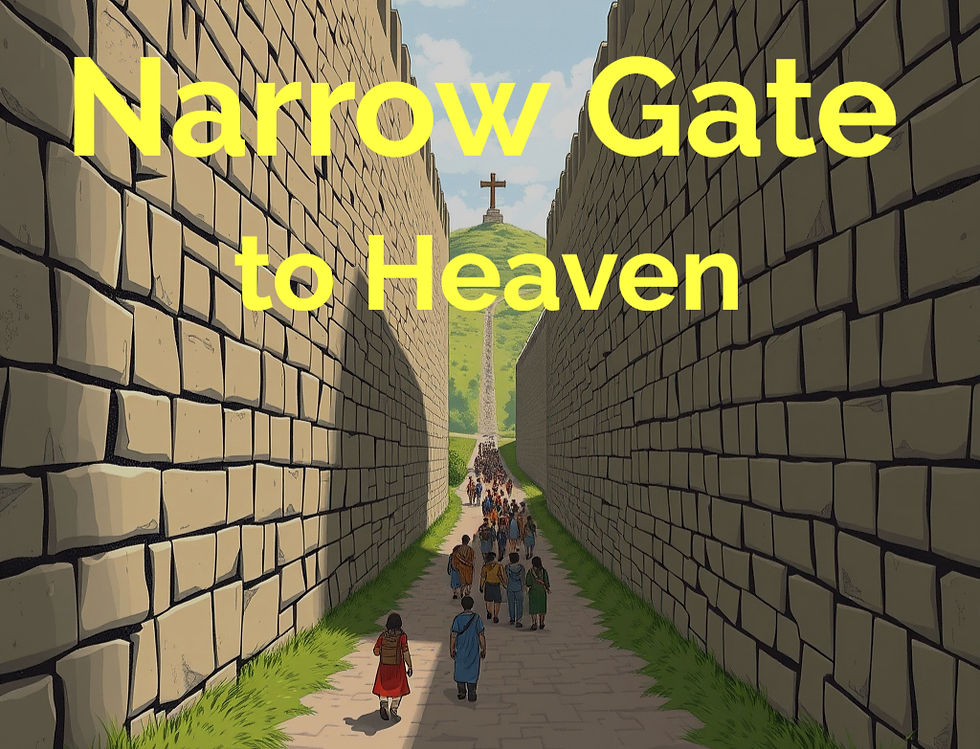
Jesus mentioned the Wide Gate to Hell —
“For the gate is wide and the way is broad that leads to destruction, and there are many who enter through it.”
Then Jesus mentioned the Narrow Gate to Heaven —
“For the gate is small and the way is narrow that leads to life, and there are few who find it” (Matt. 7:13-14).
The “narrow gate” leading a “few to heaven” is for those who recognize they can't save themselves, but must depend on Jesus Christ by faith. It's not through a belief in false gods or other religions, but only through Jesus.
“Jesus said to him, “I am the way, and the truth, and the life; no one comes to the Father but through Me” (John 14:6).
The “wide gate” leading “many to hell” is the way of the ungodly, the prideful, and the self-indulgent, who are unwilling to give up the world and all its attractions and who are unwilling to trust in Jesus alone.
The real question is, “Which path are you on?”
Do believers go straight to heaven when they die?
Yes — the repentant thief on the cross went right to heaven

A prime example of immediately going to heaven is the repentant thief on the cross alongside Jesus’ crucifixion, where Jesus said to him,
“Truly, I say to you, today you will be with me in paradise” (Luke 23:39-43).
A believer’s spirit/soul immediately goes to heaven when they die. Their body remains in the grave on earth awaiting the resurrection.
Some religious groups hold different ideas, though.
Jehovah’s Witnesses and Seventh-day Adventists teach a form of soul sleep after death until the resurrection.
The Roman Catholic Church teaches that many who die with unresolved minor sins enter a temporary place called purgatory to endure a painful process of purification before they can enter heaven.
However, there was no gap of time between the death of the thief on the cross and going to heaven.
Do unbelievers go straight to hell when they die?
Yes — a good example is the rich man who went right to hell
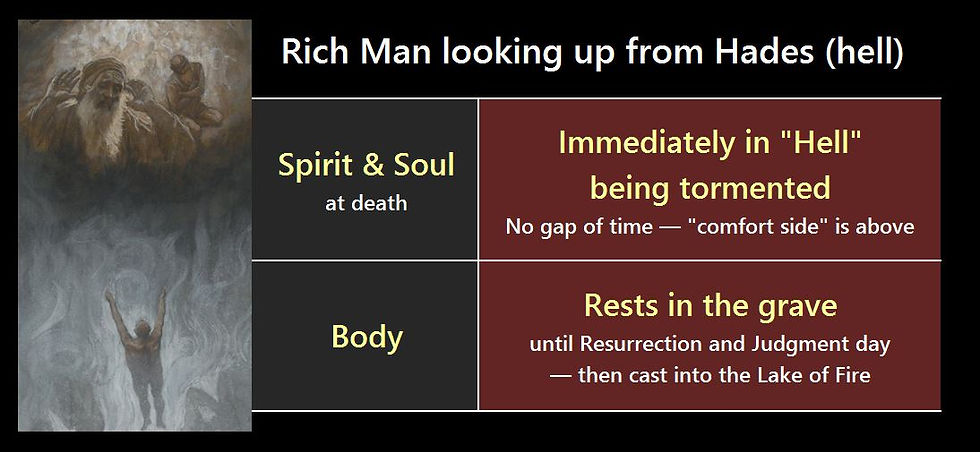
Jesus tells a story of a rich man—an unbeliever—who immediately goes to a place of torment at death called Hades (or hell). After death, the rich man looked up across a great chasm where he saw a poor beggar who had died named Lazarus (a believer) being comforted at Abraham's side (sometimes called Abraham's bosom).
“In Hades he [the rich man] lifted up his eyes, being in torment, and saw Abraham far away and Lazarus in his bosom. And he cried out and said, 'Father Abraham, have mercy on me, and send Lazarus so that he may dip the tip of his finger in water and cool off my tongue, for I am in agony in this flame’” (Luke 16:23-24).
While the primary purpose of this story is a warning against greed, the unbelieving rich man immediately finds himself in hell. He discovers that everything he had worked for is worthless. And after death, there's no way to cross the chasm from the torment side to the comfort side.
At the end of the age, an unbeliever's body is resurrected and goes before the Great White Throne for final judgment. His soul and body is then cast into the final hell called the Lake of Fire for eternal punishment. The Lake of Fire is also the final destination for Satan and his fallen angels.
Do babies or young children go to heaven when they die?
The Bible doesn't provide a direct answer — but several verses imply that babies, young children, or those with mental handicaps go to heaven when they die
All people are born with original sin at the moment of conception. But will God hold a baby responsible if they have no capacity for reasoning about God or responding to the gospel?
An important consideration is that nowhere does the Bible teach infant damnation. Scripture teaches that unbelievers are sent to hell based on their deeds of sin (Rev. 20:11-12). The dominant sin is unbelief. But infants don't fit into this group. While children do sin (disobey, are selfish, etc.), they are incapable of choosing good or evil or understanding true repentance and saving faith. They've never committed conscious deeds of rebellion against God.
How is a baby saved?
They are saved like everyone else. The accomplished work of Christ removes the stain of original sin. They are saved by the sovereign grace of God through the atonement of Christ on the cross.
We'll briefly look at some scriptural support for infant salvation and God's compassion on those not knowing right from wrong.
God spares 120,000 infants based on His compassion
Jonah was sent by God to the wicked in Nineveh to call them to repent. But Jonah was upset when the people actually repented and God didn't bring calamity upon them. The reason God gave Jonah for sparing the city was his compassion towards 120,000 infants when he said,
“Should I not have compassion on Nineveh, the great city in which there are more than 120,000 persons who do not know the difference between their right and left hand . . . ?” (Jonah 4:11).
The nature of God shows his compassion to those who are innocent and don't know the difference between their right and left hand.
God's reference to "my children" from wicked parents
God rebuked the wickedness of people sacrificing infants to the god Moloch. God referred to the infants as “my children.”
“You slaughtered My children and offered them up to idols by causing them to pass through the fire” (Ezek. 16:21).
God identified these children as “my children,” not Satan's.
Children not condemned — "no knowledge of good or evil"
When the Israelites fled captivity in Egypt, only those people aged 19 and younger were allowed to enter the promised land along with Joshua and Caleb. Why? Because they had no understanding of good or evil.
“As for your little ones . . . and your children, who today have no knowledge of good or evil, they shall go in there. And to them I will give it, and they shall possess it.” (Deut. 1:39)
However, those aged 20 and older were prevented from entering the promised land due to their numerous sinful deeds, such as worshipping a golden calf.
God did not condemn the children who were not mature enough to discern right from wrong.
King David expected to be reunited with his baby who died
King David committed adultery with Bathsheba, who bore a son that died seven days after birth. The scripture tells us David fully expected to be reunited with his baby in heaven.
David said,
“I will go to him, but he will not return to me” (2 Sam. 12:23).
This helps support a reasonable argument that babies go to heaven when they die, as David fully expected to see his baby again.
The kingdom of heaven belongs to children
Parents were bringing their children to Jesus so he would bless them. The disciples rebuked the parents, but Jesus intervened and said,
“Let the children alone, and do not hinder them from coming to Me; for the kingdom of heaven belongs to such as these” (Matt. 19:13-14).
This story is a great analogy of salvation by grace since a child cannot earn salvation. Children are completely dependent on sovereign grace to enter the kingdom of heaven.
Jesus only blessed believers, not unbelievers
Jesus picked up the children and blessed them.
“'Permit the children to come to Me' . . . And He took them in His arms and began blessing them, laying His hands on them” (Mark 10:14, 16).
Jesus only blessed believers, and in this case, children. Jesus never blessed unbelievers or the cursed. The disciples got their first lesson on God's attitude toward children when Jesus rebuked them for hindering the children who came to Him.
Children are innocent, but still guilty of original sin
Since all people inherit guilt and corruption from Adam, the salvation of an infant based on being innocent is impossible. Therefore, salvation must be in the same way all people are saved. God in His sovereign mercy extends them the atonement of Christ, electing and regenerating them entirely by grace.
But what about Paul's statement in Romans 1:19-20 that all humanity is “without excuse” because God's attributes are clearly seen in creation? A counterargument is infants are exempt because they lack the cognitive ability to perceive or reject this revelation.
Theologians who believe infants who die are saved
A partial list of older theologians includes Zwingli, Calvin, Hodge, and B.B. Warfield, who believe in infant salvation.
A few of the more recent theologians who believe infants are saved include Spurgeon, MacArthur, Piper, and Mohler.
A Protestant confession of faith by the Baptists in 1679 succinctly summarizes widely held views on infant salvation.
“We believe that all little children dying in their infancy, before they are capable to choose either good or evil, whether born of believing parents or unbelieving parents, shall be saved by the grace of God, the merit of Christ, their Redeemer, and the work of the Holy Ghost.” (1679 Orthodox Creed, Article 44, British Baptists).
Conclusions are drawn from implications
This topic of infant salvation has wide-ranging views since the Bible doesn't specifically answer this question or give an age of accountability or an age of responsibility. But a combination of the various verses mentioned above seems to imply that unborn babies, infants, young children, or those with mental handicaps go to heaven when they die.
Do pets go to heaven?
The Bible doesn’t explicitly say one way or the other — but probably not

In Genesis, man was uniquely made in the image of God. But God didn’t say he made animals in His image.
God created man with an eternal soul. But nowhere in the Bible does it say that animals have a soul or an immortal soul.
The Bible says man must believe in Christ and repent of their sins to go to heaven. But nowhere in the Bible does it say what an animal needs to do to go to heaven.
These reasons indicate that animals are not at the same spiritual level as humans.
God loves animals
Jesus said we shouldn't be worried or anxious about food or clothing. He then drew an analogy of how God takes care of the birds of the air, so I'll take care of you too since you're worth so much more than birds are.
Jesus said,
"Look at the birds of the air, that they do not sow, nor reap nor gather into barns, and yet your heavenly Father feeds them. Are you not worth much more than they?" (Matt. 6:26).
Further demonstrating God's care and concern for animals is that they are to rest from work on the Sabbath just like man was to rest.
"In it you shall not do any work . . . or your ox or your donkey or any of your cattle . . ." (Deut. 5:14).
People in the Bible loved animals
For example, when the prophet Nathan confronted King David with his sin, he used a parable describing a poor man and his children who deeply loved a small lamb they were raising. The lamb was like a daughter to him (2 Sam. 12:1-3). While the purpose of the parable was not about the poor man's love of his lamb, it held an underlying truth about a love for animals.
Conclusion
Based on animals being at a different spiritual level than humans, we might make an educated guess and say that our pets do not go to heaven—despite God and people dearly loving animals.
Animals in the Millennial Kingdom or Heaven
Scripture says there will be animals in the Millennial Kingdom.
But scripture doesn't say whether there will be animals in the new heaven and earth after the Millennium. It does say there will be a city, a river, and trees bearing fruit in the new heaven and earth, so there may be animals too, but we can't say for sure (Rev. 22).
What will we look like in heaven?
We will be like Christ; we will be healthy; but we won't know what our appearance will be
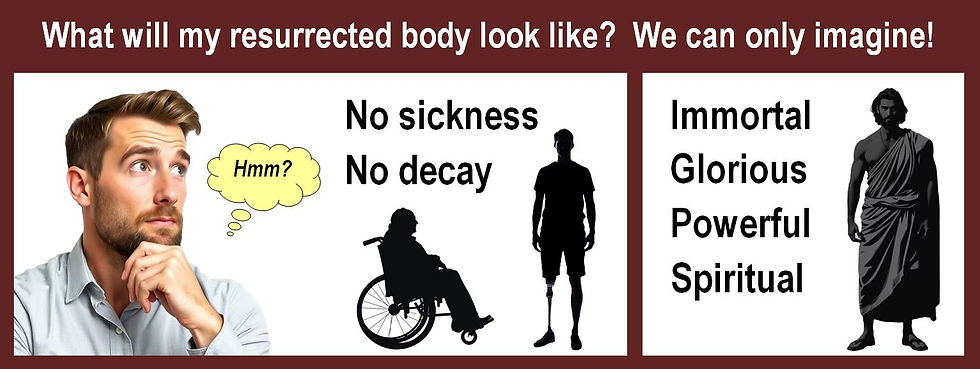
The Bible says our resurrected bodies will be transformed and will be like Christ’s “glorious body” (Phil. 3:21).
After Jesus was resurrected on the third day, He appeared on earth in a physical body to the apostles and over 500 others. He had hands and feet. He walked, talked, and reasoned with them. He broke bread and blessed it. He asked for food and ate fish. He could appear and disappear at will (Luke 24; 1 Cor. 15:6).
If we are to be like Him, we too may be recognizable to others and have a similar physical body.
But how Jesus looked—was it just temporary to be recognized by the apostles? Were the scars in his hands and side only temporary for doubting Thomas to touch? Jesus' appearance served the purpose of confirming that He had risen. Then later, when He ultimately sits on the throne in heaven, will He change from His recognizable, earthly look to something different? Likely, we can only make inferences from these examples of what our bodies will be like in heaven.
The Apostle Paul anticipated similar questions about what our body will look like. Paul said,
“But someone will say, ‘How are the dead raised? And with what kind of body do they come?’” (1 Cor. 15:35)
Paul said it's similar to sowing a dead seed, which doesn't produce another seed but a full-grown plant.
He said, “So also is the resurrection of the dead. It is . . .
-
sown a perishable body—it is raised an imperishable body
-
sown in dishonor—it is raised in glory
-
sown in weakness—it is raised in power
-
sown a natural body—it is raised a spiritual body”
An imperishable body is one that is free from disease and decay and lives forever. It seems Paul focused more on the qualities of our heavenly bodies, such as glory and power, rather than our looks (1 Cor. 15:37-44).
Our ethnicity?
Another inference that could be made is that our ethnicity may survive. Paul mentioned, when you plant a grain of wheat, it grows into a wheat plant. It doesn't grow into something else (like an olive tree). Therefore, when we die, will we be raised to look somewhat like us?
To further this idea, John's vision of the new heaven and earth mentioned nations, which may also imply various races will exist.
“The nations will walk by its light, and the kings of the earth will bring their glory into it” (Rev. 21:24).
While we are told we will be like Christ’s body in heaven, scripture also says,
“It has not appeared as yet what we will be” (1 John 3:2).
While the Bible may be vague about what we'll look like in heaven, rest assured everyone gets a substantial upgrade—a new glorious body! That includes a new body for those born with disabilities, those who lost a limb in war, those burned up in a fire, or those lost at sea.
So no one can precisely say what we’ll look like in heaven until we meet our Savior face to face.
What age will we be in heaven?
Will an old man who dies still be old in heaven? Or will he transition to an ideal age?
Various ideas about our heavenly age have been proposed, but it is all speculation.
We know the Bible says we will be transformed to be like Christ (1 John 3:2).
If Jesus started his ministry at the age of 30, is that the age we will be transformed to? Some have suggested an ideal age is 25, or maybe even younger. Or is it the age of 33 when it is estimated that Christ died?
What age we will be in heaven, no one knows. And the Bible doesn’t say.
Will we know our family and friends in heaven?
It seems we may recognize them based on several scriptures
Moses and Elijah were recognizable at their appearance at the transfiguration of Christ even though they had died centuries earlier (Matt. 17:3-4).
Jesus tells a story about a poor man named Lazarus who died and was carried by angels to Abraham’s side. A rich man also died and was in torment in Hades (hell) when he looked across a great chasm and saw Abraham with Lazarus at his side being comforted.
The rich man called out,
“Father Abraham, have mercy on me, and send Lazarus to dip the end of his finger in water and cool my tongue, for I am in anguish in this flame.”
However, the chasm could not be crossed, and the rich man was stuck in Hades. This story conveys the idea that people were recognizable after death (Luke 16:19-26).
These verses and others indicate we may reunite with family and friends in heaven.
Can people look down from heaven and see us?
The Bible doesn’t explicitly say, but probably not
Popular culture says people likely can see us from heaven. Often times an athlete will make a gesture to a mom or dad in heaven after scoring a touchdown or goal. But, we also realize, many times those gestures are not to a person but simply a thank you to God or an acknowledgement to a parent for what they taught them about that sport.
A key verse many rely on for people seeing us from heaven is Hebrews 12:1, which says,
“…we are surrounded by such a great cloud of witnesses.”
These witnesses are the Old Testament heroes of faith such as Abraham and Moses. People then speculate that these witnesses must be looking down on us from heaven. However, commentators say a better interpretation is that the heroes of faith show us an example of how to live. How to be faithful. Their lives bore witness of their faith in God despite their trials and tribulation. Nowhere does it say people are spectating from a heavenly balcony.
In John's vision of heaven during the end times, John saw the souls of those who had been martyred for their faith during the great tribulation. They called out to God to avenge their blood and judge those still on earth who killed them (Rev. 6:10). It appears they did have some type of knowledge of whether their killers still lived. But it doesn’t say whether the martyrs could see their killers or not.
The idea of loved ones watching us from heaven is more sentimental hope than scriptural fact. The Bible doesn't say people can look down from heaven and see us, so it is unlikely they can. But no one can be dogmatic about the answer to this question since the Bible doesn't explicitly say they can't.
Down here on earth our focus is not on gaining approval from people in heaven. Instead, our focus is above on Christ.
“Fixing our eyes on Jesus, the pioneer and perfecter of faith” (Heb. 12:2).
Will people be married in heaven?
No — Jesus clearly answered this question
Jesus was asked about a woman who remarried after each husband died. In heaven, the Sadducees wanted to know whose wife of her seven husbands will she be?
Jesus said,
“At the resurrection people will neither marry nor be given in marriage; they will be like the angels in heaven” (Matt. 22:30).
Marriage had significant purposes for humanity on earth, such as companionship, intimacy, and procreation. Marriage is also a picture of our relationship with Christ.
After we join Christ in heaven, the illustration of marriage will no longer be applicable, as we will be united with Christ forever.
Will we look like angels?
When Jesus stated in the above verse that we “will be like angels in heaven,” some people presume that we will look like angels in heaven. But Jesus' focus was that angels aren't married in heaven, so neither will humans. Therefore, being like angels is not about looks but how we will relate to our earthly spouse once we're in heaven. So we can't push this verse too far and stretch it from its focus on marriage to how we'll look in heaven.
Will we be naked in heaven?
Probably not based on several verses
Some people arrive at this idea of being naked in heaven because clothes were only needed after Adam and Eve sinned. But before that, they were naked and unashamed (Gen. 2 and 3). Therefore, they reason that when Adam’s curse is removed in heaven, clothing will not be needed like God’s original creation.
However, scripture says believers in heaven will be clothed.
“He who overcomes will thus be clothed in white garments” (Rev. 3:5).
In John's vision of heaven, he says around the throne of God,
“I saw twenty-four elders sitting, clothed in white robes” (Rev. 4:4).
Based on these descriptions of people clothed in white in heaven, it appears we will not be naked.
Will we work in heaven?
It appears we will do some type of work in heaven
While scripture says believers will “rest from their labors,” it also says in the new holy city of Jerusalem that “the throne of God and of the Lamb shall be in it, and His servants shall serve Him” (Rev. 14:13; 22:3).
We'll serve God and Jesus in this city on a newly recreated earth. So you can throw out the imagery of floating in the clouds and strumming on harps.
In God’s original design, Adam had a job in the Garden of Eden “to work it and take care of it.” And Eve was Adam’s helper. But after the fall, work became difficult, and “cursed is the ground because of you; in toil you will eat of it” and “by the sweat of your face you will eat bread” (Gen, 2:15, 20; 3:17-19).
One consideration is that our work will return to what it was like before the fall in the Garden of Eden, where work was fulfilling and enjoyable.
John's vision of the New Jerusalem coming down out of heaven included the tree of life “bearing twelve kinds of fruit, yielding its fruit every month” (Rev. 22:2). Will we need to pick this fruit? We don't really know.
Another consideration is that God is at work in heaven. Jesus said,
“My Father is always at work to this very day, and I too am working” (John 5:17).
The exact details of how we will work in the new heaven and new earth are not spelled out in scripture. But it will be beyond our imagination.
“What no eye has seen, nor ear heard, nor the heart of man imagined, what God has prepared for those who love him” (1 Cor. 2:9).
Are there three levels of heaven?
People ask this because Paul had a vision of the third heaven

The idea of three levels of heaven comes from a vision Paul had where he was “caught up to the third heaven” (2 Cor. 12:2). In ancient times, it was common to refer to three heavens or realms—namely, the sky, outer space, and paradise.
-
The first heaven is the earth's sky, where birds fly.
-
The second heaven is outer space, meaning the stars, planets, and galaxies.
-
The third heaven would be the spiritual realm where God resides.
So the third heaven Paul referred to is what we refer to simply as heaven or paradise. There is only one heaven a believer goes to at death.
What are five crowns that are awarded in heaven?
They are given for showing self-control, sharing the gospel, living a faithful life, shepherding the flock, and enduring trials


Rewards are given when believers appear at the “bema” or “judgment” seat of Christ. In ancient Greek times, the bema seat was an elevated platform where victorious athletes (eg., during the Olympics) received a “wreath of leaves” or “garland” placed on their head or around their neck. The Bible figuratively calls these crowns.
“For we must all appear before the judgment seat of Christ, so that each one may be recompensed for his deeds in the body, according to what he has done, whether good or bad” (2 Cor. 5:10).
This judgment seat of Christ (bema) is an evaluation of a believer's stewardship, motives, and faithfulness on earth to determine their heavenly reward or loss of reward. It is not for the punishment of sin since they were fully borne by Christ on the cross. The last word in the verse, “bad,” is better interpreted as “useless” or “worthless” activities for the Lord. They won't be rewarded, nor will they be punished.
Another verse relates “useless” activities by believers to “wood, hay, and stubble” that are burned up at the end. But “useful” activities for the Lord are called “gold, silver, and precious stones,” and they make it through the fire and are rewarded (1 Cor. 3:12-15).

1. The Imperishable Crown – This everlasting crown is for those who exercise self-control and faithfully run the spiritual race.
Like an athlete, we exercise self-discipline.
“Every athlete exercises self-control in all things. They do it to receive a perishable wreath [crown], but we an imperishable [crown]” (1 Cor. 9:25 ESV [NKJV]).
It also conveys the idea that we don’t store up treasures on earth that decay and perish like an athlete’s wreath of leaves that fades away. Instead, we store up our treasure in heaven like a king’s golden crown that lasts forever (Matt. 6:19-20).
2. The Crown of Rejoicing – This crown is for those who evangelize, share the gospel, and disciple others. It’s sometimes called the “soul-winners” crown.
Paul was rejoicing that people he led to Christ would stand with him in heaven when he said,
“For what is our hope, or joy, or crown of rejoicing? Is it not even you in the presence of our Lord Jesus Christ at His coming?” (1 Thess. 2:19-20 NKJV).
3. The Crown of Righteousness – This crown is for those who live a faithful, holy life and who eagerly look forward to Christ’s second coming.
As Paul reflects on the end of his life as he faces execution in Rome, he writes,
“I have fought the good fight, I have finished the course, I have kept the faith; in the future there is laid up for me the crown of righteousness, which the Lord, the righteous Judge, will award to me on that day; and not only to me, but also to all who have loved His appearing” (2 Tim. 4:7-8).
Paul says this crown is not just for him, but it’s also for those who eagerly look forward to Christ’s return. It reflects a mindset focused on eternity, not the trials of this present life.
4. The Crown of Glory – This crown is for elders, pastors, and church leaders who shepherd the flock of God.
Peter exhorted church elders to exercise oversight willingly, not under compulsion, and not in a domineering way, but with eagerness. They should act as examples, not do it for financial gain.
Peter said,
“And when the Chief Shepherd appears, you will receive the unfading crown of glory” (1 Peter 5:2-4).
5. The Crown of Life – This crown is promised to those who endure trials, suffering, and persecution out of a love for God.
James writes about the testing of our faith:
“Blessed is the man who perseveres under trial; for once he has been approved, he will receive the crown of life which the Lord has promised to those who love Him” (James 1:12).
Those who are martyred will also receive this crown:
“Do not fear what you are about to suffer . . . Be faithful until death, and I will give you the crown of life” (Rev. 2:10).
Purpose of the Crowns
The pursuit of these crowns is meant to encourage faithful living on earth and not for future boasting in heaven about how great we were on earth.
Since only Jesus is worthy of glory and honor, it may be that believers will cast these crowns at the feet of Jesus when they enter heaven.
In John’s vision of heaven,
“…the twenty-four elders will fall down before Him who sits on the throne, and will worship Him who lives forever and ever, and will cast their crowns before the throne” (Rev. 4:10).
By storing up treasure in heaven, it appears believers in heaven will have something meaningful to give back to God in worship.
What does it mean “to be absent from the body and present with the Lord”?
If you die, you will be in heaven with the Lord
First, understand “absent from the body” means to die. At death, a believer’s spirit/soul separates from their body and immediately goes to heaven to be present with the Lord.
Paul says,
“We are confident, I say, and willing rather to be absent from the body, and to be present with the Lord” (2 Cor. 5:8 KJV).
The physical body remains in the grave until resurrection day, when it will be transformed into a new, glorified body and be reunited with its spirit/soul in heaven.
Is there a temporary heaven and hell?
Yes — there is an intermediate state between death and one's resurrected body

When one dies, the soul goes immediately to heaven or hell. This is the beginning of the intermediate state. Later, the soul will join their resurrected body, which ends the intermediate state.
The terms used in the Bible for describing these events, including simple words like heaven and hell, can be confusing and are subject to much debate. Let's dig in.
The grave is called Sheol or Hades, but sometimes hell
Upon death, the soul goes to what is commonly referred to as the “realm of the souls” or the “grave.”
The Hebrew term in the Old Testament for the location of departed souls is “Sheol.”
The equivalent Greek term in the New Testament is called “Hades.”
Both of these terms are sometimes referred to as hell and other times as just the grave.
The grave (Sheol/Hades) is divided into a torment side (hell) and blessing side (paradise)
Sheol/Hades may be further divided into two areas by a great gulf or chasm: a place of blessing and a place of torment. This division is derived from the story of the rich man in torment in Hades looking across a great chasm and seeing the blessing side with Abraham and the poor man Lazarus by his side (Luke 16).
The “blessing” part of Sheol/Hades is referred to in various scriptures as “paradise” or “Abraham’s bosom” (Luke 16; 23:43).
The “torment” part of Sheol/Hades is typically translated as “hell.”
A believer's soul on the paradise (heaven) side of the grave will receive a new glorified body in the future
Believers, whose souls are in heaven or “paradise,” will ultimately receive a new glorified body and enter the new heaven and new earth described in Revelation 21.
When this reuniting of the soul and body occurs depends on one's view of end times. Some see it occurring at three events: the rapture, the second coming of Christ, and at the end of the millennium. Others see it only at one or two of these events.
An unbeliever's soul on the torment (hell) side of the grave will be resurrected, judged and cast into the final hell
Unbelievers, whose souls are on the “hell” side of Sheol/Hades, have their bodies resurrected and stand before Jesus at the Great White Throne judgment at the end of the age.
"And I saw the dead, the great and the small, standing before the throne" (Rev 20:12).
The graves are emptied when the Bible says,
"the sea gave up the dead which were in it, and death and Hades gave up the dead which were in them; and they were judged, every one of them according to their deeds (Rev. 20:13).
After the unbeliever's physical body and the spiritual soul are reunited, they are thrown into the final hell called the Lake of Fire. What this physical body in hell consists of is not clearly spelled out in scripture. However, the physical body in hell will be tormented day and night, and it will experience weeping and gnashing of teeth, whether literally or figuratively (Rev. 20:10; Matt. 8:12).
Jesus used Gehenna as a metaphor for hell
When the word “hell” is translated from the Greek word “Geenna,” or “Gehenna,” it generally points to the final hell, whereas Hades generally points to the grave.
Gehenna is a reference to the cursed “Valley of Hinnom” just south of Jerusalem, where children were sacrificed by fire to the god Molech. This location of detestable fire became a metaphor for future punishment in hell (Matt. 5:29; 23:33).
In the gospels, Jesus primarily used “Gehenna” (translated as hell) to portray one's ultimate destruction. He less frequently used the word “Hades” (translated as hell, or realm of the dead), such as in the story of the Rich Young Ruler and Lazarus, where there was the torment side and comfort side of Hades.
Our chart is repeated here to summarize everything
At death, a person's soul goes to heaven or to hell. Once in heaven or hell, a great chasm exists that never can be crossed.
At some time in the future, everyone's physical body will be resurrected and rejoined with their spiritual soul and sent to their final destination.
Believers — will go to the "New Heaven and New Earth."
Unbelievers — will go to the final hell, the "Lake of Fire."
(Revelation 20 and 21).
Is hell for eternity?
Yes — hell is forever, but not all people agree
Some people argue that when an unbeliever dies, they are simply annihilated (go out of existence). But that’s not what the Bible says.
The descriptive language in the Bible says hell is clearly forever.
-
The fire is not quenched — (Mark 9:48)
-
Their worm does not die — (Mark 9:48)
-
Burn with unquenchable fire — (Matt. 3:12)
-
Everlasting destruction — (2 Thess. 1:9)
-
Tormented day and night forever — (Rev. 20:10)
-
Everlasting shame and contempt — (Dan. 12:2)
All these verses tell us that hell is for eternity. Those who believe in Jesus Christ as their savior will escape this eternal fate in hell.
What is annihilationism, and is it biblical?
Annihilationism says, at death, you cease to exist
This means after death and judgment, your soul ceases to exist, and you won't spend eternity in hell. Where does this idea come from? It’s a misinterpretation of two concepts.
First, an annihilationist says that if the unbeliever’s resurrected body is cast into the Lake of Fire, it would be immediately consumed. They would cease to exist. However, the Lake of Fire is both a physical and spiritual realm. An unbeliever’s body is prepared for an eternal fate. Plus, the spiritual nature is not consumed.
Secondly, the annihilationist says that the Greek word for ‘eternal’ (aionios) does not always mean forever. It can sometimes refer to an ‘age’ or a specific period of time.
However, Revelation 20 is very clear that the devil is cast into the Lake of Fire, and he “will be tormented day and night forever and ever.” The word ‘eternal’ is never used in this instance. Instead, ‘forever and ever’ is used. The last verse in chapter 20 also says that unbelievers are also “thrown into the lake of fire” (Rev. 20:10, 15).
If the devil is in the Lake of Fire ‘forever and ever’ without using the word ‘eternal,’ further proof is found in Jesus' own words when he says,
“Depart from Me, accursed ones, into the eternal fire which has been prepared for the devil and his angels” (Matt. 25:41).
Essentially, these unbelievers are going to the same torment as the devil, which we read earlier was forever and ever.
The best verse to refute annihilation is in Matthew 25:46. It uses the same Greek word, ‘eternal,’ for both believers and unbelievers. It says,
“These [unbelievers] will go away into ‘eternal’ punishment, but the righteous [believers] into ‘eternal’ life.”
Another verse to refute annihilation is in Daniel 12:2. It says those who have died will awake,
“some to ‘everlasting’ life, and some to shame and ‘everlasting’ contempt.”
In these verses, ‘eternal’ and ‘everlasting’ are compared equally with believers and unbelievers. So both groups are forever.
But if ‘eternal’ and ‘everlasting’ are just finite periods of time, the annihilationist would have to take a position that both believers and unbelievers will cease to exist. However, there are too many verses about a believer’s eternal life in heaven that an annihilationist couldn't refute. Therefore, the annihilationist’s argument falls apart.
Are there different levels of punishment in hell?
Levels are not mentioned, but there appear to be degrees of punishment
The idea of levels of punishment in hell comes from a popular poem written by Dante called The Divine Comedy. It portrays nine circles of hell, with each lower level representing people who were more wicked than those above. Traitors like Judas Iscariot, who betrayed Jesus, and Brutus and Cassius, who betrayed Julius Caesar, are at the lowest level, where they are being perpetually chewed by Satan. However, nine levels of hell don’t match up with the Bible.
Instead, the Bible indicates there may be different degrees of punishment depending on our actions in this life.
Let's look at several potential areas of comparative punishment.
Judged on how much gospel was heard and rejected
Punishment seems to be tied to the amount of light or how much of the gospel someone has heard and rejected.
In Luke 10, Jesus told the apostles that when you go to a town and they reject you,
“I tell you, it will be more bearable on that day for Sodom than for that town.”
The background of this verse is that the sexually immoral town of Sodom never had Jesus preach to them, but God still destroyed it with fire and brimstone. However, the town that rejected the apostles will be punished even more severely than the city of Sodom.
Jesus also tells the story of two groups of hired servants who got either a “severe beating” or a “light beating,” indicating degrees of punishment. Both did things worthy of punishment, but one group had more understanding than the other about what they did wrong (Luke 12:47-48).
Judged on the accumulation of sin (quantity)
Punishment also seems related to our amount of sin. Every time we sin, we are storing up God's wrath. It's like making a deposit in a bank that we will eventually withdraw in judgment.
Paul says,
“But because of your stubbornness and unrepentant heart you are storing up wrath for yourself in the day of wrath and revelation of the righteous judgment of God, who will render to each person according to his deeds” (Rom. 2:5-6).
Judged on the severity of sin (degree)
The apostle John also shows us that a higher degree of sin results in a higher degree of punishment when he referenced the wickedness of Babylon.
John heard an angel from heaven saying,
“. . . for her sins have piled up as high as heaven . . . give back to her double according to her deeds; in the cup which she has mixed, mix twice as much for her . . . to the degree that she glorified herself and lived sensuously, to the same degree give her torment and mourning” (Rev. 18:5-7).
The punishment was double the sin committed.
Judged on influencing others to sin and reject God
There appears to be greater punishment for those who cause or influence others to sin or to reject God.
Jesus said,
“Whoever causes one of these little ones who believe in Me to stumble, it would be better for him to have a heavy millstone hung around his neck, and to be drowned in the depth of the sea” . . . “but woe to that man through whom the stumbling comes” (Matt. 18:6-7).
In another verse, Jesus condemns the scribes and Pharisees for blocking the way to salvation for themselves and for others.
Jesus said,
“Woe to you . . . For you shut the kingdom of heaven in people's faces. For you neither enter yourselves nor allow those who would enter to go in” (Matt. 23:13).
Today, these verses may apply to parents who turn their kids away from Christ or to those who influence their friends to reject Christ. It seems that wicked influencers will suffer a greater punishment on judgment day.
Judged according to what they have done
The overarching premise is that unbelievers at the Great White Throne will be judged according to what they have done, and they will all be thrown into the final hell, the Lake of Fire.
“Then I saw a great white throne and Him who sat upon it . . . And I saw the dead, the great and the small, standing before the throne . . . and they were judged, every one of them according to their deeds. . . And if anyone's name was not found written in the book of life, he was thrown in the lake of fire” (Rev. 20:11-15).
Rather than speculating too much on the degrees of punishment in hell, we should focus on avoiding hell at all costs and helping others avoid it too.
Is eternity in hell a fair punishment for sin?
The rich young ruler in hell never said, “This is not fair!”
God is loving and merciful, but He is also righteous and just. In our courts if someone kills your family, justice locks them up forever. It wouldn’t be fair if the courts let the killer go free. Likewise, God, in His holiness, cannot tolerate sin. He has to execute punishment. If He failed to punish sin, He would be unjust.
God is infinitely holy in His nature, and crimes against Him deserve an infinite penalty—eternity in hell.
In Luke 16 the rich young ruler, after going to Hades (hell), never says, “I do not deserve this” or “This is not fair!” Instead, he asks Father Abraham to go to his brothers who are still alive and warn them so they don’t end up in torment like him.
Fortunately, Christ took all our sins upon himself. Then God, being just, executed punishment upon His son at the cross so that we are set free from an eternity in hell.
Summary on heaven and hell
Trust in Christ to go heaven and avoid hell at all costs
It's not very popular these days for pastors to talk much about hell. It scares people. It's confrontational. People might stop coming to church. So a pastor might soften the gospel message.
But Jesus mentioned hell or symbolic references to it more than any other person in the Bible. It's the fate that awaits all men by default. We are all guilty. No one is righteous. Hell is where we're headed.
Fortunately, Jesus came to earth to save us. To save us from what? Eternity in hell.
The Bible describes hell as
-
Unquenchable fire
-
Outer darkness
-
Everlasting destruction
-
Torment, day and night forever
-
Burning fire and brimstone
-
Weeping and gnashing of teeth
The alternative is heaven, which is described as
-
No more death, disease, or decay
-
No tears, crying, or mourning
-
No more pain or curse
-
All things are made new
-
An imperishable body
-
A glorious, powerful, spiritual body
The message of salvation is simple. Romans 10:9 says,
“If you confess with your mouth Jesus is Lord, and believe in your heart that God raised him from the dead, you will be saved.”
The Bible says the knowledge of God is evident within everyone through Creation and what He has made. Therefore, all are without excuse. Unfortunately, people suppress the truth that there is a God. Why? So they can keep on sinning. They don't want to be accountable, so they deny God.
Every reader of this article has received plenty of gospel light regarding the two options for eternity. One can't claim ignorance. Is it the broad way to hell? Or is it the narrow way to heaven?
If you have never believed in Jesus Christ as your savior, today is the day! Don't delay!
You can learn more about Salvation on our Salvation page here.
Individual Articles — Heaven and Hell
From the all-in-one article above
What is purgatory, and is it biblical?
Sermons — Heaven and Hell
Sermons on Heaven — learn more about heaven on our Heaven & Hell web page. A few are shown below.

Sermons on Hell — learn more about hell on our Heaven & Hell web page. A few are shown below.

Explore more topics and sermons
For all of our recommended videos and teachings on Heaven and Hell, visit our Heaven & Hell page on this site.
Heaven and Hell Topics
Heaven Sermons – Best sermons to learn from
Hell Sermons – Best sermons to learn from
Last Judgment Sermons – Best sermons to learn from
Other Topics
Creation vs Evolution – Evolution is debunked
End Times – What does the future hold; four views
False Teachings – Learn to identify deceptions
Salvation – Find out how to go to heaven
Evangelism – Equip yourself to share the gospel
Questions & Answers – Get answers to life's big questions
Christian Movies – Free Christian movies and Bible stories
Marriage – Marriage, divorce, remarriage, and singleness
Next Article — End Times

Discover what each view teaches about the Rapture, Tribulation, Second Coming of Christ, Millennium, Antichrist, Last Judgment, Heaven and Hell. It's complete with graphs, charts and surveys for a high-level overview of End Times.
Article • 2026 • BibleSurf.com (this site)
Copyright to images, content and text shown in this article is retained by the respective owners and has been procured from various websites, including but not limited to BibleSurf.com, Bible Content Ministries, Wikipedia Public Domain (Rich Man and Lazarus James Tissot 1895), YouTube, Wix, Vimeo and other sources.