

Article — Heaven and Hell — Q & A
What is annihilationism, and is it biblical?
Annihilationism says, at death, you cease to exist
This means after death and judgment, your soul ceases to exist, and you won't spend eternity in hell. Where does this idea come from? It’s a misinterpretation of two concepts.
First, an annihilationist says that if the unbeliever’s resurrected body is cast into the Lake of Fire, it would be immediately consumed. They would cease to exist. However, the Lake of Fire is both a physical and spiritual realm. An unbeliever’s body is prepared for an eternal fate. Plus, the spiritual nature is not consumed.
Secondly, the annihilationist says that the Greek word for ‘eternal’ (aionios) does not always mean forever. It can sometimes refer to an ‘age’ or a specific period of time.
However, Revelation 20 is very clear that the devil is cast into the Lake of Fire, and he “will be tormented day and night forever and ever.” The word ‘eternal’ is never used in this instance. Instead, ‘forever and ever’ is used. The last verse in chapter 20 also says that unbelievers are also “thrown into the lake of fire” (Rev. 20:10, 15).
If the devil is in the Lake of Fire ‘forever and ever’ without using the word ‘eternal,’ further proof is found in Jesus' own words when he says,
“Depart from Me, accursed ones, into the eternal fire which has been prepared for the devil and his angels” (Matt. 25:41).
Essentially, these unbelievers are going to the same torment as the devil, which we read earlier was forever and ever.
The best verse to refute annihilation is in Matthew 25:46. It uses the same Greek word, ‘eternal,’ for both believers and unbelievers. It says,
“These [unbelievers] will go away into ‘eternal’ punishment, but the righteous [believers] into ‘eternal’ life.”
Another verse to refute annihilation is in Daniel 12:2. It says those who have died will awake,
“some to ‘everlasting’ life, and some to shame and ‘everlasting’ contempt.”
In these verses, ‘eternal’ and ‘everlasting’ are compared equally with believers and unbelievers. So both groups are forever.
But if ‘eternal’ and ‘everlasting’ are just finite periods of time, the annihilationist would have to take a position that both believers and unbelievers will cease to exist. However, there are too many verses about a believer’s eternal life in heaven that an annihilationist couldn't refute. Therefore, the annihilationist’s argument falls apart.
Related Articles — Heaven and Hell
What is purgatory, and is it biblical?

Get quick, short answers in one article on over 20 frequently asked questions. Learn about Heaven — What's it like? Babies? Pets? Our looks? Our age? See family? Married? Naked? Work? Levels? Rewards? Learn about Hell — What's it like? Who goes there? Temporary hell? Final hell? Levels of punishment? Is it fair? Annihilation? And much more.
Article • 2026 • BibleSurf.com (this site)
All questions in one article
Sermons — Heaven and Hell
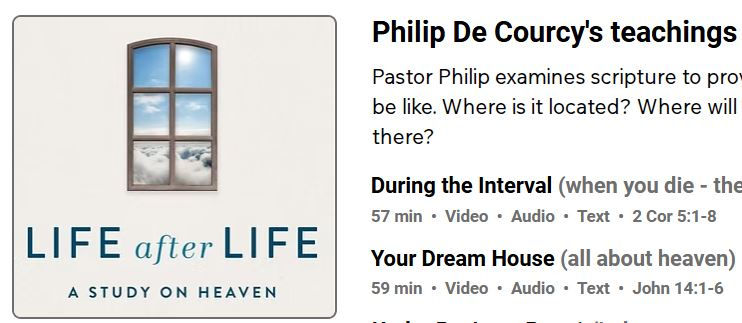
Sermons on Heaven — learn more about heaven on our Heaven & Hell web page. A few are shown below.

Sermons on Hell — learn more about hell on our Heaven & Hell web page. A few are shown below.


Explore more topics and sermons
For all of our recommended videos and teachings on Heaven and Hell, visit our Heaven & Hell page on this site.
Heaven and Hell Topics
Heaven Sermons – Best sermons to learn from
Hell Sermons – Best sermons to learn from
Last Judgment Sermons – Best sermons to learn from
Other Topics
Creation vs Evolution – Evolution is debunked
End Times – What does the future hold; four views
False Teachings – Learn to identify deceptions
Salvation – Find out how to go to heaven
Evangelism – Equip yourself to share the gospel
Questions & Answers – Get answers to life's big questions
Christian Movies – Free Christian movies and Bible stories
Marriage – Marriage, divorce, remarriage, and singleness
Copyright to images, content and text shown in this article is retained by the respective owners and has been procured from various websites, including but not limited to BibleSurf.com, Bible Content Ministries, Wikipedia Public Domain (Rich Man and Lazarus James Tissot 1895), YouTube, Wix, Vimeo and other sources.